
When a Scan Shows No Heartbeat: Understanding the Finding and Your Options

Week-by-week guide

Follows NICE guidance

Being told that no heartbeat can be seen is devastating, and it often happens at a scan you expected to be routine. Below, our team explains what the finding can mean between 7 and 12 weeks, when UK guidance says a repeat scan is needed first, and what can be tested if it is a miscarriage.

Early on, the picture is not always clear: dates worked out from a period can be misleading, and the embryo may simply be too small for a heartbeat to be seen yet. When a pregnancy has stopped developing, the most common recognised reason is a chance chromosome change, not something you did.

First

If you have just been told there is no heartbeat

Often there is no warning. You may have had no bleeding or pain and still feel pregnant, because pregnancy hormones can remain raised after a pregnancy stops developing, and a home test may still be positive. So the news tends to arrive at a scan you expected to be routine, which can make it very hard to take in.

UK guidance says that before a miscarriage is confirmed there should be a second opinion, a repeat scan or both, depending on what the scan measured, so there is rarely any need to decide anything on the day. And if it does turn out to be a miscarriage, the most common recognised cause is a chance chromosome change in the pregnancy, not something either parent did.

The scan

What the person scanning you is looking for

The clearest early view comes from an internal (transvaginal) scan. NICE (the body that writes clinical guidance for the NHS in England) says the person scanning should look for a heartbeat first; at this stage it appears as a tiny flicker.

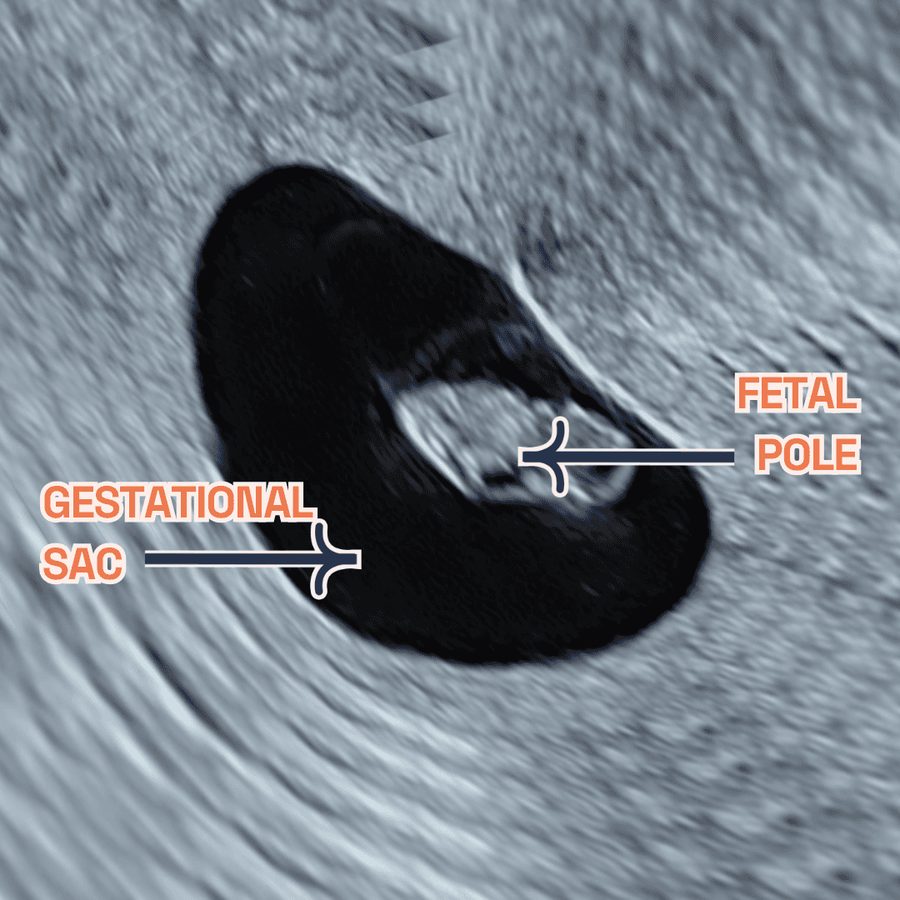
If an embryo is visible without a heartbeat, they measure its length from head to bottom, called the crown–rump length (CRL). If there is no embryo, they measure the pregnancy sac in three directions and average them, called the mean sac diameter (MSD). These sizes, not the week in your notes, decide what happens next, so it is worth asking for them if they are not on your report.

Early pregnancy ultrasound image with the gestational sac and the fetal pole labelled
An early scan showing the pregnancy sac and the embryo (fetal pole), the two structures that are measured

UK guidance

When a repeat scan or second opinion is needed

NICE guideline NG126 sets these rules for the NHS in England. They are cautious on purpose: NICE accepts that one scan cannot be guaranteed to be 100% accurate, especially very early on.

What the scan showsMeasurementBefore a diagnosis is made
Embryo, no heartbeat (internal scan)CRL under 7 mmRepeat scan 7 or more days later, sometimes more than one
Embryo, no heartbeat (internal scan)CRL 7 mm or moreSecond opinion and/or a repeat scan 7 or more days later
Sac, no embryo (internal scan)MSD under 25 mmRepeat scan 7 or more days later, sometimes more than one
Sac, no embryo (internal scan)MSD 25 mm or moreSecond opinion and/or a repeat scan 7 or more days later
Either finding on a tummy scan onlySize recordedRepeat scan 14 or more days later

Period dates should not be used on their own to judge whether a heartbeat ought to be visible, and the wait itself does no harm to a pregnancy that is continuing.

Is the 7 mm line safe? A later UK study of 2,845 women with an uncertain first scan supported it: no pregnancy that went on to continue had an embryo of 7 mm or more without a heartbeat. Among embryos with no heartbeat that did continue, the largest measured 6 mm.

Week by week

No heartbeat at 7, 8, 9, 10 or 12 weeks

The week in your notes is an estimate; the scan measurements guide what happens next. Average sizes below are from the INTERGROWTH-21st international standards, which start at 9 weeks.

07

No heartbeat at 7 weeks

From about 6 weeks a visible heartbeat becomes the most common finding on an internal scan, and the chance of a clear answer keeps rising until about 7 weeks. Even so, no heartbeat at 7 weeks by dates can mean the pregnancy is younger than expected, for example if you ovulated later than usual.

In a large UK study, about 1 in 6 embryos with no heartbeat at an inconclusive first scan were ongoing pregnancies at 11 to 14 weeks; the other 5 in 6 were not. A repeat scan a week or more later usually makes the picture clear, though sometimes more than one is needed.

08

No heartbeat at 8 weeks

An embryo without a heartbeat at 8 weeks often also measures small for the dates. Either the pregnancy started later than you thought, or it stopped developing a while ago. Under 7 mm, a repeat scan a week or more later usually tells the two apart; in the same study, close to 9 in 10 pregnancies whose repeat scan showed a heartbeat were still continuing at 11 to 14 weeks.

09

No heartbeat at 9 weeks

The average embryo at 9 weeks is about 2 cm, far beyond the 7 mm line, so with reliable dates a heartbeat would normally be expected. No heartbeat at this size usually points to a missed miscarriage, meaning development has ended but the pregnancy has not yet passed. A second opinion and/or a repeat scan still comes before confirmation.

10

No heartbeat at 10 weeks

By 10 weeks the average embryo is just over 3 cm. If your dates are certain and an embryo well past 7 mm has no heartbeat, a missed miscarriage is very likely. Even so, NICE does not shorten its steps for later weeks: a second opinion and/or a repeat scan still comes first.

NICE also advises against relying on period dates alone, because cycles vary. In the UK study, about 1 in 5 women could not recall when their last period began.

12

No heartbeat at the 12-week scan

In England the first routine scan, the dating scan, is offered at around 10 to 14 weeks, and this is where many missed miscarriages are first found. Usually the scan shows a sac with an embryo but no heartbeat, and the embryo measures smaller than expected; the average at 12 weeks is about 5.5 cm.

If the scan was through your tummy, you may be offered an internal one for a clearer view; a tummy-only finding needs a repeat at least 14 days later. Development may have stopped weeks earlier. That delay is common, and usually nothing except a scan could have shown it.

While you wait

Between scans: practical steps

1

Write down the details

Was the scan internal or through the tummy? Was a CRL or a sac size measured, and what was it? These explain when the next scan should be, wherever you have it.

2

Keep a 24-hour number

NICE says you should have a number for someone experienced in early pregnancy problems, day or night.

3

Know when to call 999

The NHS advises calling 999 if bleeding is heavy, or if it comes with severe tummy pain, shoulder pain or feeling faint or dizzy.

4

Look into testing early

Some genetic tests depend on timing, so it helps to know the options before any treatment starts. Our genetic counsellors can talk them through with you by video.

Causes

What usually lies behind it

The most common recognised cause is a problem with the pregnancy's own chromosomes, the structures that carry genetic instructions. Roughly half of early miscarriages are explained this way: the pregnancy had extra or missing chromosomes, or rearranged chromosome material, and could not develop normally.

Such changes are usually random slips while an egg or sperm is being made, or in the earliest divisions after conception; the parents' chromosomes are typically normal. Chance errors in eggs rise with age, one reason miscarriage is more common in older women. Other factors are mainly investigated after repeated losses, and often none is found. See chromosomal causes, and whether anything you did played a part.

Chromosome findings in tested miscarriages

Pooled figures from the RCOG recurrent miscarriage guideline; exact proportions vary between studies and laboratories.

About 1 in 2 Early miscarriages caused by a chromosome change in the pregnancy
About 52 in 100 Abnormal results that are a trisomy, one extra chromosome
About 19 in 100 Abnormal results with a whole extra set, such as triploidy
About 15 in 100 Abnormal results with a missing chromosome, most often an X
6 to 7 in 100 Abnormal results with part of a chromosome missing, extra or moved

Once confirmed

Managing a confirmed miscarriage, and how it affects testing

NICE describes three ways to manage a missed miscarriage, and the choice affects which genetic tests are practical. Our missed miscarriage page explains each in more depth.

Letting it happen in its own time

Usually offered first, for 7 to 14 days, unless there is a reason such as a higher bleeding risk to choose otherwise. Tissue may pass at home, so collecting it can be hard; a blood-based test works best before anything passes.

Tablets

A 200 mg mifepristone tablet, followed two days (48 hours) later by 800 micrograms of misoprostol. A blood-based test needs the pregnancy to still be in the womb, so it is usually taken before the first tablet; ask whether tissue that passes can be kept.

A procedure

Manual vacuum aspiration under local anaesthetic, or surgery under general anaesthetic. Tissue is collected at the time, which usually makes tissue testing simpler, provided a sample reaches the laboratory fresh, not in formalin.

Genetic testing

Genetic testing after a confirmed diagnosis

Testing is optional. It can sometimes explain a loss but cannot promise an answer, and a normal result does not exclude every cause. What is possible depends mainly on whether pregnancy tissue is still inside the uterus.

TestWhenWhat it looks atWorth knowing
Blood-based test (cell-free DNA)Before the pregnancy has passed, ideally before treatmentPlacental DNA in your blood, for extra or missing chromosomesScreening only. In pooled studies it detected roughly 78 in 100 changes that tissue testing confirmed, and about 9 in 100 losses with normal tissue got a false abnormal result. It usually misses triploidy, and some tests fail. Not an NHS test for miscarriage.
Pregnancy tissue testAfter a procedure, or if tissue is collectedThe pregnancy's chromosomes; on the NHS, a rapid test plus a chromosomal microarrayNeeds fresh tissue, not in formalin. Microarray needs no living cells, unlike older culture methods that fail in about 1 in 5 samples. Typically offered from the third loss, or after any loss in the second trimester.
Parents' chromosomes (karyotype)Any time, by blood testWhether a parent carries a balanced rearrangementNot routine. Usually only if tissue shows an unbalanced rearrangement, or tissue could not be tested.

Next: what can I test now?, testing before a miscarriage completes, blood-based testing and pregnancy tissue testing.

Next steps

NHS care, and where we fit in

Your NHS early pregnancy unit handles repeat scans, second opinions and miscarriage care free of charge; your local NHS trust website, maternity notes or NHS 111 can help you reach it. You can ask for a second opinion if you are unsure. NHS tissue testing is arranged by the hospital team.

Some people also choose a private appointment: a repeat scan at a time that suits them, an independent second opinion, or a conversation about genetic testing the NHS may not offer in their situation. Seeing us privately does not affect your NHS care, and you can use both.

Wherever you go, ours included, it is reasonable to ask what a test can and cannot show, and what a result could change, before deciding.

How we can help

How London Miscarriage Clinic can help

No referral is needed. Our fetal medicine doctors and specialist sonographers scan at our clinics in the City of London and West London, and our genetic counsellors see you by video. London Miscarriage Clinic is part of London Pregnancy Clinic, so booking opens on the London Pregnancy Clinic website. If you are not sure which appointment fits, ring 020 3687 2939 or send an enquiry below.

6–9 weeks

Repeat early scan

When the embryo is small or your dates are uncertain, one of our fetal medicine doctors or specialist sonographers scans you again, looks for a heartbeat and re-measures the embryo or sac. In line with NICE, it is timed at least 7 days after the earlier scan. You leave with your images and a written report.

From around 10 weeks

Second-opinion scan

Dr Fred Ushakov, a fetal medicine specialist, rescans you at our City clinic and reaches an independent view before looking at earlier reports. He explains what he sees, and his written report reaches you by the end of the same day.

Online, 30 minutes

Genetic counselling

A video appointment in which one of our registered genetic counsellors goes through whether any test suits your situation, what each can and cannot show, and how the timing fits around the way you choose to manage the miscarriage. Testing of pregnancy tissue is arranged through this appointment rather than booked online.

After your first period

Post-miscarriage scan

A recovery scan and review, usually after your first period following the miscarriage, to check that the womb has returned to normal and to look for any pregnancy tissue left behind. It checks recovery only, so it cannot be used to confirm a miscarriage.

Questions after a no-heartbeat scan

Could it just be too early to see a heartbeat?

Sometimes, if the embryo is very small or not yet visible, which is why a repeat scan is required below the size cut-offs. It becomes less likely the further on you are. If an embryo still has no heartbeat on a repeat scan at least a week later, the diagnosis is very reliable: in the UK study, none of nearly 200 pregnancies in that situation continued.

There was a heartbeat at an earlier scan. What changed?

A pregnancy can stop developing after a heartbeat has been seen, and a chance chromosome change is often the reason. The earlier scan was not wrong, and the same second-opinion and repeat-scan steps still apply.

Will I need an internal scan?

It gives the clearest view and is what the NICE size rules are based on, but it is your choice. If you prefer a scan through the tummy, its limits mean the repeat is set at least 14 days later instead of 7.

Can the scan tell when the pregnancy stopped?

Only roughly. An embryo stops growing when development stops, so its size hints at the stage it reached, which may be weeks before the scan. It cannot give an exact date.

Do I need other tests to find out why?

Not usually after one early miscarriage. UK guidance suggests checks for antiphospholipid syndrome (an immune condition affecting blood clotting), thyroid function and the shape of the womb after three miscarriages, or after two if a cause is suspected; see recurrent miscarriage. None of these looks at the pregnancy itself; only genetic testing does that.

Do I need a referral to have a scan with you?

No. You can book a repeat early scan or a second-opinion scan with us directly, online or by phone on 020 3687 2939, without a letter from your GP. Bring any earlier scan reports if you have them, so the doctor can see what was measured before. With your agreement, we can send our report to your GP or early pregnancy unit.

Where can I get emotional support?

The Miscarriage UK helpline (0303 003 6464) is there for anyone affected, and its website explains missed miscarriage in detail. It is also fine to ask your early pregnancy unit what support it can offer or suggest locally.

About this information

This page gives general information and cannot replace advice from the clinicians who know your scans and history. If bleeding is heavy, pain is severe or felt in your shoulder, you develop a fever, or you feel faint or dizzy, ring your early pregnancy unit or NHS 111 straight away; in an emergency, dial 999.

Contact

Talk to us about a repeat scan or testing

Send us an enquiry

Ask about a repeat scan, a second opinion or genetic testing. Not for emergencies: for heavy bleeding, severe pain or feeling faint, ring 999.

For urgent matters please call 020 3687 2939.

Sources & clinical references

The figures and clinical statements on this page are drawn from the sources below. Guidance evolves — always discuss your individual circumstances with a clinician.

  1. NICEEctopic pregnancy and miscarriage (NG126): diagnosis of viable intrauterine pregnancy (recommendations 1.5 and 1.6)2026
  2. NICEEctopic pregnancy and miscarriage (NG126): management of miscarriage2026
  3. BMJ (Preisler et al.)Defining safe criteria to diagnose miscarriage: prospective observational multicentre study2015
  4. Human Reproduction (Bottomley et al.)The optimal timing of an ultrasound scan to assess the location and viability of an early pregnancy2009
  5. Ultrasound in Obstetrics & Gynecology (Papageorghiou et al., INTERGROWTH-21st)International standards for early fetal size and pregnancy dating based on ultrasound measurement of crown–rump length in the first trimester of pregnancy2014
  6. Miscarriage UKMissed miscarriageAccessed October 2026
  7. NHSMiscarriage2026
  8. NHS12-week scan (dating scan)2023
  9. RCOGRecurrent Miscarriage (Green-top Guideline No. 17)2023
  10. NHS EnglandNational Genomic Test Directory: testing criteria for rare and inherited disease (v9.1), R318 and R4642026
  11. Prenatal Diagnosis (Pauta et al.)Genome-wide cell-free DNA analysis for aneuploidy detection in miscarriages: test performance meta-analysis2025
  12. Human Reproduction (El Sammaa-Aru et al.)How big is the time window for cell-free fetal DNA testing after pregnancy loss?2026