
Trying Again After a Chromosomal Miscarriage: Genetic Advice, Scans and Screening

If testing showed that your miscarriage was caused by a chromosome change, it is natural to worry that it could happen again. Usually the change arose by chance and, once age is allowed for, a chromosomal cause is linked with a better outlook next time than a loss in which the chromosomes were normal.

Here we work through three questions to consider before or early in a new pregnancy: having the result explained by a genetics specialist, what an early scan can add, and how screening tests such as NIPT differ from diagnostic tests. We set out the NHS routes first, then how our team can help.

Where you are starting from

What a chromosomal result usually means for next time

Chromosomes are the packages of genetic instructions inside every cell. According to RCOG guidance, around half of early miscarriages are due to the pregnancy developing with abnormal chromosomes, and in most cases both parents' own chromosomes are normal.

So a chromosomal explanation, painful as it is, often carries some reassurance. The RCOG guideline on recurrent miscarriage notes that a chromosome change in a lost pregnancy points to a better outlook next time than normal chromosomes do, once age is allowed for. That comparison has limits: an older woman with a chromosomal loss may still face lower odds than a younger woman whose loss had normal chromosomes, and the reassurance may not apply if either parent carries a chromosome rearrangement.

The NHS advises that you can try again when you feel ready, once miscarriage symptoms have gone. Some of the options below have time windows, so it helps to know about them early, even if you are not ready to decide anything yet.

Your report

How the type of chromosome change shapes the plan

The precise finding matters more than the word 'chromosomal'. If you do not have the report, ask the hospital that arranged the test for a copy. Our page on understanding your result explains the terms, and our genetic counsellors can go through your own report with you.

What the report showedChance or inherited?What it can mean next time
A full trisomy 21, 18 or 13 (a whole extra copy of one of these chromosomes)Almost always chance; more common as the egg gets olderIn England, NHS NIPT can be offered from 10 weeks in any later pregnancy (the R445 pathway). NHS England's guidance works on a chance of a trisomy recurring of around 1 in 100, or the usual figure for your age if higher.
Another trisomy, such as trisomy 16 or 22Almost always chance; more common as the egg gets olderNot covered by R445. A North American study found that, after a loss with one of these trisomies, prenatal testing in a later pregnancy showed a trisomy compatible with birth, such as Down's syndrome, at about 1.8 times the rate expected for the mother's age. Even so, the chance remains low.
Monosomy X (a single X chromosome) or triploidy (a whole extra set)Usually chance; these arise in a different way from the common trisomiesIn the same North American study, later pregnancies were no more likely than expected for age to have a trisomy. If the report described a partial molar pregnancy, finish the hormone (hCG) follow-up and wait until your doctor says it is safe to try again.
An unbalanced rearrangement (a piece of chromosome missing or extra)Sometimes inherited, when a parent has a balanced versionBoth partners are usually offered their own chromosome test. See checking both partners' chromosomes.

Question 1: genetic advice

Having the result explained by a genetics specialist

A genetics specialist may be a genetic counsellor or a clinical geneticist, a doctor who specialises in inherited conditions. They can explain what was found, whether it arose by chance or could have been inherited, and what it means for a future pregnancy.

On the NHS, referral to the regional clinical genetics service usually comes from your GP, your early pregnancy unit or a specialist recurrent miscarriage service. RCOG guidance on recurrent miscarriage says both partners should be offered chromosome testing if the pregnancy tissue showed an unbalanced rearrangement, and that finding a parental rearrangement should lead to referral to a clinical geneticist. Whatever the result, you can ask whether a genetics referral would help.

If the earlier pregnancy had a full trisomy 21, 18 or 13, NHS England guidance says you should be referred as early as possible in your next pregnancy to talk options through with a genetic counsellor, a fetal medicine consultant or a specially trained midwife.

You can also see a genetics specialist with us, without a referral. Our registered genetic counsellors see you by video, and your partner is welcome to join. For a finding that may be inherited, or one that is mosaic or hard to interpret, Dr Harry Leitch, Consultant in Clinical Genetics, can review your reports.

Questions to take to that conversation

Bring the laboratory report if you can, whether you see your NHS genetics service or our team.

Was the whole chromosome involved, or only part of it?

Was this most likely chance, or could it have been inherited?

Do either of us need our own chromosomes checked, and would the answer change anything?

What is the chance of the same change, or a different one, next time at my age?

Which tests would you suggest in a future pregnancy, and from how many weeks?

Can a test in pregnancy be aimed at what was found last time?

Question 2: early scans

What an early scan can, and cannot, add

After a loss, many people want to see as soon as possible that a new pregnancy is in the womb and has a heartbeat. An early scan can show that and may bring reassurance, but it cannot show the pregnancy's chromosomes. Our early viability scan at 6 to 9 weeks is for exactly this. It does not replace your early pregnancy unit if you have pain or bleeding.

We also offer a specialist 10-week scan. A scan at this stage can look at some major structures that are already visible. It does not replace the NHS scan at 11 to 14 weeks or the 20-week scan, and it cannot rule out physical conditions. Some features cannot yet be judged at 10 weeks: ISUOG expects the skull bones to be visible by 11 completed weeks, and until about 11 weeks it is normal for some of the bowel to lie outside the baby's tummy.

International guidance (ISUOG, 2023) recommends an early anatomy check between 11 and 14 weeks, with much of the detail easiest to see at around 13 weeks. Some major conditions still develop later or cannot be seen, which is why the 20-week scan is offered too.

Scans and NIPT answer different questions. NIPT looks at chromosomes but cannot detect physical differences; a scan looks at physical development but cannot show the chromosomes. ISUOG advises against relying on NIPT without the 11 to 14 week scan.

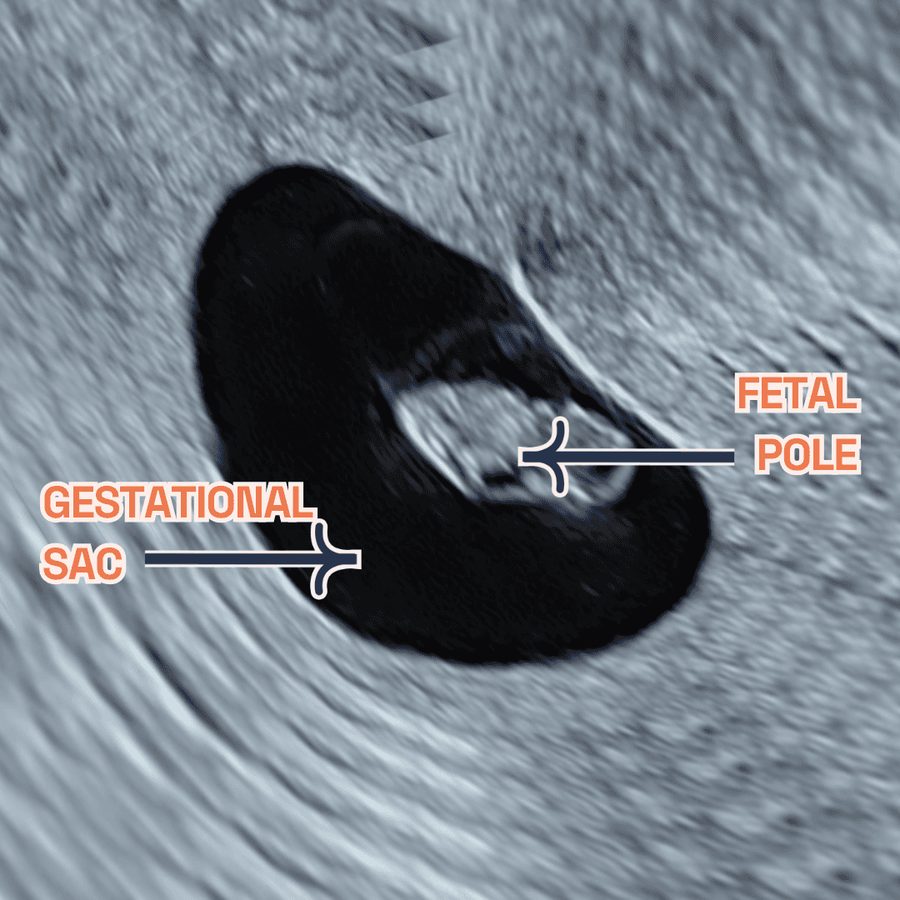
Ultrasound picture of an early pregnancy, labelled to show the gestational sac with the fetal pole within it
In the first weeks a scan mainly shows the sac, the developing pregnancy and its heartbeat. Anatomy comes later.

Question 3: screening

Screening for chromosome conditions: NHS and private routes

Screening tells you how likely a condition is rather than giving a definite answer. Whichever route you take, tell your midwife about the earlier result. After a full trisomy 21, 18 or 13, NHS England guidance says R445 NIPT is offered instead of the combined test, because it is the more sensitive test for those three conditions.

NHS

NHS combined test

Offered to most pregnant women: a blood test at 10 to 14 weeks plus the neck-fluid measurement taken during the 11 to 14 week scan, combined with your age. If your result is 1 in 150 or higher, it is classed as 'higher chance', and you can then choose NHS NIPT, a diagnostic test, or no further testing. It is not offered on the R445 route.

NHS

NHS NIPT after a previous full trisomy 21, 18 or 13

In England, if an earlier pregnancy, including one that miscarried, was reported to have a full trisomy 21, 18 or 13, the R445 pathway lets you go straight to NIPT from 10 weeks up to 21 weeks and 6 days. It looks only at those three chromosomes, and is not offered if the earlier change was partial, mosaic or due to a translocation.

Private

Private NIPT for the common trisomies

Offered by private clinics, including ours, usually alongside a scan, and sometimes adding the sex chromosomes. In pooled studies, NIPT picks up about 997 in 1,000 pregnancies with Down's syndrome, with very few false alarms, but it is still a screening test and occasionally gives no result.

Private

Private genome-wide NIPT

Looks across all the chromosomes, including larger missing or extra pieces. Many of the rarer changes it flags affect only the placenta: when the Netherlands offered it nationally (the TRIDENT-2 study), about 6 in 100 high-chance results for rarer trisomies turned out to be present in the baby.

Weighing it up

Is a broader NIPT worth it after a chromosomal loss?

The appeal is easy to see. If your loss involved a chromosome other than 21, 18 or 13, standard NIPT would not look at it, whereas a genome-wide test would. Several laboratories offer genome-wide NIPT in the UK under different names, and they differ in what they report and in the smallest change they can reliably detect.

The genome-wide test we offer is NIPTIFY, among the most comprehensive genome-wide NIPT tests you can have privately in the UK. It remains a screening test, as every NIPT does, and we always pair it with a scan.

The drawback is that a change in the placenta is not always present in the baby (confined placental mosaicism), so rare findings bring more false alarms. The charity Antenatal Results and Choices (ARC) suggests thinking carefully before choosing NIPT for extra conditions, and asking a clinical geneticist or genetic counsellor if you are unsure. It also advises checking that a private provider has a clear link with an NHS unit in case a result is worrying.

R445 NIPT is not used when one parent has a balanced translocation that involves chromosome 21, 18 or 13. More generally, NIPT may not detect partial trisomies or translocations, so where a specific inherited change is known, a genetics team will usually discuss a diagnostic test aimed at it instead. Whatever test you use, a high-chance NIPT result is not a diagnosis and should be checked with CVS or amniocentesis before any decision about the pregnancy.

Diagnostic tests

When you want a definite answer: CVS and amniocentesis

A diagnostic test examines cells from the placenta or from the fluid around the baby and gives a definite answer for the chromosomes tested. The extra risk of miscarriage is likely to be below 1 in 200 when a skilled specialist does it (RCOG); NHS leaflets quote about 1 in 200. You can choose one after a higher-chance screening result or, where your history allows, without screening first.

Usually 11 to 14 weeks

Chorionic villus sampling (CVS)

A fine needle, guided by ultrasound, takes a small sample of placental tissue. It gives the earliest diagnostic answer and should not be done before 10 weeks.

From 15 weeks

Amniocentesis

A fine needle, guided by ultrasound, draws off a little of the fluid that surrounds the baby. It is done later than CVS, so the answer also comes later.

When a change is already known

Testing aimed at the earlier finding

If a specific change has been found in the family, such as a parent's rearrangement, the NHS test directory allows clinical genetics to request testing in pregnancy aimed at it. This is another reason to have the report reviewed early.

Putting it together

An outline of the next pregnancy, stage by stage

1

Before trying again

Get the earlier report explained, complete any parental chromosome tests you have been advised to have, and start folic acid as recommended.

2

A positive pregnancy test

Tell your GP or midwife about the earlier result. After a full trisomy 21, 18 or 13, ask for an early referral to discuss NHS NIPT.

3

From 10 weeks

R445 NIPT can be taken once a scan confirms 10 weeks, and private NIPT is possible from this point too. Some prefer to wait for the 11 to 14 week scan, as anything seen on it can help them choose between NIPT and a diagnostic test.

4

11 to 14 weeks

The NHS dating scan, with the combined test if you choose it and are not on the R445 route. CVS is possible in this window.

5

From 15 weeks

Amniocentesis becomes possible, as a first choice or to follow up a screening result.

6

Around 20 weeks

The 20-week screening scan checks the baby's physical development in detail, whatever tests you have had.

NHS and private routes

Finding genetic advice, scans and testing

On the NHS, start with your GP or, once pregnant, your midwife. They can refer you to clinical genetics when your result calls for it, arrange routine scans and screening, and refer you to a fetal medicine team for CVS or amniocentesis. If you qualify for R445 NIPT, it is part of NHS care, so it is worth asking about before paying for a private test.

Privately, genetic counsellors and clinical geneticists can review a report and help you plan, and private clinics, ours included, offer early scans and NIPT, including genome-wide tests. Whoever you see, it is reasonable to ask how a worrying result would be followed up.

CVS and amniocentesis are not procedures we carry out. When one is being discussed, we talk the choices through with you and can refer you on: to your NHS fetal medicine unit, which does the test free of charge when it is recommended, or to a fetal medicine specialist in private practice if that suits you better.

Trying again after a loss can bring back difficult feelings. Two charities offer emotional support by phone: Miscarriage UK on 0303 003 6464 and Tommy's on 0800 0147 800.

How we can help

Support for your next pregnancy at London Miscarriage Clinic

Whether you are still planning or already pregnant, these are the appointments we offer at this stage. You can book them yourself, without a referral, and they sit alongside your NHS care rather than replacing it. Appointments take place at our City and West London clinics or online. London Miscarriage Clinic is part of London Pregnancy Clinic, so booking opens on the London Pregnancy Clinic website. If you are not sure where to start, call us or message us on WhatsApp.

Online, 30 minutes

Genetic counselling

A video appointment with our registered genetic counsellors, led by Ailidh Watson. Bring the earlier report: we go through what was found, whether it was most likely chance, whether either of you needs a chromosome test and which tests suit your next pregnancy. Partners are welcome. For a complex history, choose the 60-minute appointment (£140).

Doctor-led, by enquiry

Clinical genetics consultation

For a finding that may run in the family, such as an unbalanced rearrangement, or one that is partial, mosaic or hard to interpret, Dr Harry Leitch, Consultant in Clinical Genetics, can review your reports and family history and advise on testing in a future pregnancy. Appointments last 30 to 90 minutes and are arranged by enquiry.

Next pregnancy · 10–11 weeks

10-week scan

A specialist scan that dates the pregnancy and looks at some major structures that are already visible at this stage. It cannot show the chromosomes, and it does not replace the NHS 11 to 14 week scan or the 20-week scan. Many people have it at the same visit as NIPT.

From 10 weeks · scan included

NIPTIFY with a scan

Genome-wide NIPT that screens all the chromosomes, including missing or extra pieces larger than about 1 Mb, so it also looks beyond chromosomes 21, 18 and 13. A scan is always included, and the laboratory usually reports within 5 to 10 working days of receiving the sample. It is a screening test: a high-chance result needs confirming with CVS or amniocentesis.

Questions about trying again after a chromosomal loss

Is a trisomy more likely in our next pregnancy?

It can be higher than average, although it usually stays small. After a full trisomy 21, 18 or 13, NHS England's guidance works on a chance of around 1 in 100, or your age-related chance if higher. For comparison, the NHS screening handbook puts the general chance of a baby with Down's syndrome at about 1 in 900 at age 30 and 1 in 100 at 40 (at 16 weeks of pregnancy).

A parent's balanced translocation, or rarely a mother who has some cells with an extra chromosome 21, 18 or 13 (mosaicism), changes the picture, and R445 is not used in those cases.

Is NHS NIPT available if our loss had trisomy 16 or 22?

Not through the previous-history route, which covers only a full trisomy 21, 18 or 13. You will still be offered the standard combined test, and you can raise your history with your midwife, a genetics service or one of our genetic counsellors if you would like to talk through other options.

Can I skip NIPT and have CVS or amniocentesis instead?

It is a personal choice. CVS or amniocentesis settles the question for the chromosomes examined, at the cost of a small extra risk of miscarriage; NIPT cannot harm the pregnancy but only estimates a chance. People who carry a rearrangement, or who would want certainty whatever screening showed, sometimes choose CVS or amniocentesis directly. A fetal medicine specialist can talk through timing and risks.

Our earlier result came from a blood test, not tissue. Does that change anything?

It can. A blood-based result after miscarriage is a screening-type result: it usually agrees with tissue testing but not always, and it can miss some changes, such as triploidy or a mix of normal and abnormal cells.

Ask a genetics specialist, such as one of our genetic counsellors, how much weight to give it, and bring the report: eligibility for NHS routes such as R445 depends on the earlier result showing a full trisomy, and whether a blood-based result is accepted is for the genetics team or NIPT laboratory to decide. Our page on the blood test explains its limits.

Does using donor eggs change the picture?

NHS England's guidance notes that the raised chance of a trisomy recurring lies with the person whose egg was used. So the R445 pathway does not apply to a pregnancy from a donor egg, unless the egg came from the same donor as the earlier affected pregnancy. Equally, if the earlier pregnancy came from a donor egg and this one is from your own egg, R445 is not offered. A genetics specialist or your fertility clinic can explain what this means for your screening.

Can I book tests for my next pregnancy myself, without a referral?

Yes. You can book genetic counselling, an early scan, a 10-week scan or NIPT with a scan yourself, without a GP referral, and your NHS midwife and GP stay involved as usual. A clinical genetics consultation is arranged by enquiry. If you are eligible for NHS NIPT through R445, it is worth knowing that before choosing a private test, and we are happy to talk it through.

About this information

This page describes the options in general and is not personal medical advice; the clinicians who know your history and results, including our team if you see us, are best placed to advise you. If you are pregnant and have heavy bleeding, strong pain or a high temperature, or you feel faint, get help quickly from your early pregnancy unit or maternity unit or by ringing NHS 111; in an emergency, ring 999.

Contact

Want to talk your result through before trying again?

Send us an enquiry

Tell us briefly what the earlier result showed and whether you are planning or already pregnant, and our team will get back to you. This form is not for emergencies. For heavy bleeding, severe pain or feeling faint, ring 999.

For urgent matters please call 020 3687 2939.

Sources & clinical references

The figures and clinical statements on this page are drawn from the sources below. Guidance evolves — always discuss your individual circumstances with a clinician.

  1. RCOGRecurrent Miscarriage (Green-top Guideline No. 17)2023
  2. NHS England R445 Working GroupNon-invasive prenatal testing (NIPT) for women with a previous pregnancy with trisomy (T21, T18 and T13): guidance for healthcare professionals on offering R4452026
  3. NHS EnglandNational Genomic Test Directory: testing criteria for rare and inherited disease, v9.1 (R445, R448, R465)2026
  4. GOV.UK (NHS fetal anomaly screening programme)Fetal anomaly screening programme handbook: screening for Down's syndrome, Edwards' syndrome and Patau's syndrome2026
  5. GOV.UK (NHS fetal anomaly screening programme)Screening tests for you and your baby: Down's syndrome, Edwards' syndrome and Patau's syndrome2026
  6. ISUOG (Ultrasound in Obstetrics and Gynecology)ISUOG Practice Guidelines (updated): performance of 11-14-week ultrasound scan2023
  7. American Journal of Human Genetics (van der Meij et al.)TRIDENT-2: national implementation of genome-wide non-invasive prenatal testing as a first-tier screening test in the Netherlands2019
  8. RCOGAmniocentesis and Chorionic Villus Sampling: Green-top Guideline No. 82021
  9. American Journal of Human Genetics (Warburton et al.)Trisomy recurrence: a reconsideration based on North American data2004
  10. Antenatal Results and Choices (ARC)Non-invasive prenatal testing (NIPT), also known as cfDNA screeningAccessed October 2026
  11. NHSMiscarriage2026
  12. NHSMolar pregnancy2023