
UK guidance (RCOG, 2023)
Three or more first-trimester miscarriages. They do not have to be consecutive, or all with one partner, and investigating can begin after a second loss when a doctor thinks something specific may be behind it.
More than one miscarriage often raises a hard question: is something causing this, or has it been chance each time? Investigations sometimes find a cause, and a few causes can be treated. Often, though, the losses turn out to be separate chance events, or no cause is found at all.
Here we explain how the UK and European definitions differ, what testing each lost pregnancy adds, when both partners' chromosomes are checked, and which other investigations and treatments have evidence. Our consultant gynaecologists and genetic counsellors can then help you plan what to do next.
Definitions
Three or more first-trimester miscarriages. They do not have to be consecutive, or all with one partner, and investigating can begin after a second loss when a doctor thinks something specific may be behind it.
Two or more pregnancy losses, not counting ectopic or molar pregnancies. Some UK private clinics use this broader definition.
One loss in the second trimester (after the first three months of pregnancy) is enough for investigations to be offered, including chromosome testing of the pregnancy tissue.
The honest answer
Because miscarriage is common, repeated losses are sometimes a run of separate chance events. A chromosome change in the developing pregnancy remains the most common cause, after one miscarriage and after several.
Older age, a very low or high body weight, smoking, heavy drinking or high caffeine intake, antiphospholipid syndrome and some differences in the shape of the womb are all linked with a higher chance of miscarriage. Even so, a cause is often not found after the recommended tests (UK patient guidance says most cases stay unexplained), and the outlook is usually still good.
Genetics and repeated loss
When chromosomes are involved in repeated losses, the key question is whether each was a separate accident or whether something is being passed on, and genetic testing helps tell these apart.
Most chromosome changes in a miscarriage arise from a chance slip when eggs or sperm are produced, and the parents' own chromosomes are usually normal. These slips become more common as eggs age, especially from the late 30s, so they can affect more than one pregnancy without anything being inherited. European guidance finds a chromosome change in about 45 in 100 single miscarriages and about 39 in 100 miscarriages that follow recurrent losses.
In a Japanese study of 1,309 women who had lost 2 to 20 pregnancies in a row, the share of miscarriages with normal chromosomes went up as the number of previous losses rose. Repeated losses with normal chromosomes can point to an underlying cause that persists, which is why other investigations matter.
Less often, one of the partners has a balanced rearrangement: their chromosome material is all there but arranged differently. This does not affect their health, though a pregnancy may receive an unbalanced form and miscarry. Estimates range from about 3 to 6 couples in every 100 with recurrent miscarriage. Even for these couples, the rearrangement accounts for only around one loss in three.
A normal result means no chromosome cause was found for that loss; it does not rule out other causes. In the same study, among 131 women followed into another pregnancy, around 4 in 10 whose previous miscarriage had a chromosome change miscarried again, against around 6 in 10 when its chromosomes were normal. UK guidance agrees that a chromosome change usually means a better outlook once age is allowed for, though not when a parent carries a rearrangement.
Group averages from large studies, not predictions for any one person.
Tissue testing
One result explains one loss, but results from several pregnancies can show a pattern: mostly chance chromosome errors, mostly normal chromosomes, or an inherited rearrangement. Each leads to a different next step.
In the UK, testing of pregnancy tissue should be offered from the third miscarriage and after any second-trimester loss. NHS laboratories run a quick check for the most frequent chromosome changes alongside a chromosomal microarray, which looks across every chromosome for missing or extra material.
Tissue has to reach the laboratory fresh, not in formalin. In a large Danish study, close to a third of women either could not collect tissue or collected a sample that was likely to be their own rather than the pregnancy's. NHS testing guidance adds that when tissue testing has failed, testing any future loss is the most informative next step. More in chromosome testing of pregnancy tissue.
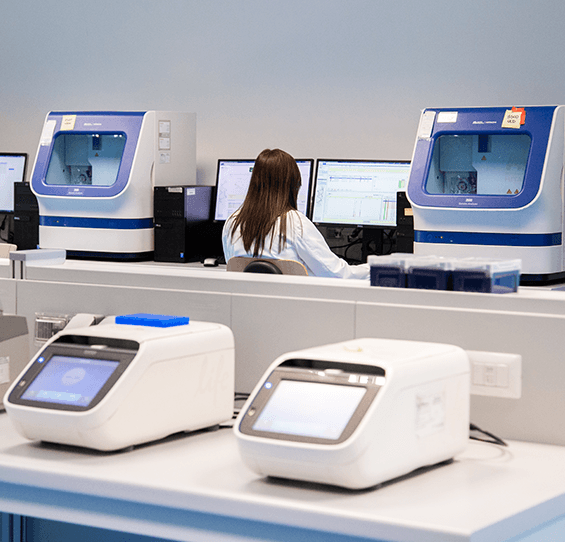
Genetic testing options
The pregnancy is usually tested first, and the parents only if a result or the circumstances call for it.
| Test | What it looks at | When it is usually considered | Main limits |
|---|---|---|---|
| Pregnancy tissue | The lost pregnancy's chromosomes, usually by microarray | From the third loss on the NHS; UK guidance also advises it after any second-trimester loss | Needs fresh tissue; some samples fail or turn out to be the mother's cells |
| Blood test before the pregnancy passes | Placental DNA circulating in your blood | Miscarriage confirmed but not yet passed, and tissue may be hard to collect | Not part of the NHS pathway; misses some changes; can give no result |
| Parental karyotype | Both partners' own chromosomes | After an unbalanced rearrangement in tissue, or when no tissue result was possible | Low yield without a specific reason |
| Genetics consultation | Your results and family history | After a rearrangement, an uncertain finding or a relevant family history | Advice and planning, not a test |
In the largest study so far (the Copenhagen Pregnancy Loss Study, Lancet 2023), the blood test detected 85 out of every 100 chromosome abnormalities identified by testing the tissue, and roughly 1 in 9 samples gave no clear answer. A 2025 review pooling eight studies put detection lower, at about 78 in 100.
Parental testing and genetics
A karyotype of both partners' blood looks for a balanced rearrangement. UK guidance offers it when tissue from a loss shows an unbalanced structural change, or when tissue testing failed or was not possible. On the NHS, that second route needs at least three losses where tissue testing failed and none of the earlier losses was tested, or at least five untested losses. European guidance decides case by case.
If one of you carries a rearrangement, you should be referred to a genetics team, who can explain your chances, including the low chance of a continuing pregnancy with an unbalanced change. In a large Dutch study, carrier couples had more miscarriages but were as likely as others to have a healthy child.
Choices include trying again naturally with the offer of CVS or amniocentesis; IVF with testing of each embryo for the rearrangement before transfer (PGT-SR), which may reduce miscarriages, without any proven gain in the overall chance of having a baby; or donor eggs or sperm. See testing parents' chromosomes.
Wider investigations
UK guidance says these checks should be offered to everyone with recurrent miscarriage, with other tests added only if your history suggests them.
Antibodies that make the blood more likely to clot, linked with repeated miscarriage and later pregnancy complications. Blood tests look for lupus anticoagulant and anticardiolipin antibodies (some clinics add anti-beta-2 glycoprotein I). Diagnosis needs two positive results at least 12 weeks apart, at least 6 weeks after a miscarriage.
A blood test of thyroid hormone levels and thyroid peroxidase (TPO) antibodies. A raised TSH level or thyroid antibodies may mean a higher chance of miscarriage, whereas well-controlled thyroid disease does not cause miscarriage.
A pelvic ultrasound, ideally 3D. About 13 in 100 women with recurrent miscarriage have an unusually shaped womb, such as one divided by a wall of tissue (a septum), against 5 to 6 in 100 women overall.
Tests for diabetes, polyendocrine metabolic ovarian syndrome (PMOS, previously called PCOS) or prolactin if your history suggests them. After a second-trimester loss, tests for Factor V Leiden, the prothrombin gene and protein S may be offered, ideally within research.
If a cause is found
Only a few treatments have good evidence. UK guidance supports these.
| Situation | What is usually recommended | Points to know |
|---|---|---|
| Antiphospholipid syndrome | Low-dose aspirin plus heparin injections, starting when the pregnancy test turns positive and continuing to at least 34 weeks | Offered after discussing benefits and risks; these pregnancies still carry a higher risk of complications, so you will be monitored closely |
| Bleeding in early pregnancy after a previous miscarriage | Vaginal progesterone 400 mg twice daily once ultrasound has located the pregnancy inside the womb, kept up until 16 weeks if a heartbeat is seen (NICE) | No benefit shown when there is no bleeding |
| A uterine septum | Surgery to remove it may be considered | Ideally within audit or research, as the evidence is limited |
| Diabetes or thyroid disease | Good control before the next pregnancy | Thyroid medicine is not routinely advised for antibodies alone with normal hormone levels |
| No cause found | Supportive care, ideally in a dedicated recurrent miscarriage clinic, with scans for reassurance | No medicine has been proven to reduce the risk of a further loss, apart from progesterone if you bleed |
Worth knowing
UK guidance does not recommend these routinely, and some only within research, because they have not been shown to improve the chance of having a baby. If one is offered, it is fair to ask what the result would change.
Looking ahead
Most people with recurrent miscarriage do eventually have a baby. Depending on the study, somewhere between two-thirds and three-quarters go on to have a successful pregnancy, and UK guidance puts the chance with supportive care alone at around 3 in 4 when no cause has been found.
Age and the number of losses matter most. In a large Danish study, about 8 in 10 women aged 20 to 24 had a baby within five years, against about 4 in 10 of those aged 40 or over. The figure was about 7 in 10 after three miscarriages and about 5 in 10 after six or more.
Recurrent miscarriage also goes with a higher chance of some problems later in pregnancy, for example an early (premature) birth or a baby who grows more slowly than expected, which is why closer monitoring may be suggested. See planning ahead for another pregnancy.
Points to raise with your GP, your early pregnancy unit or our team.
Keep copies of every result so each new team sees the whole picture.
Ask in advance how tissue from any future loss would be collected and sent fresh, and whether a blood-based test is an option if tissue is unlikely.
If you have APS, agree a treatment plan before you conceive.
Stop smoking, cut out or limit alcohol, keep caffeine under 200 mg a day and aim for a BMI of 19 to 25 if you can.
Check how to reach your early pregnancy unit directly: NICE advises that these units take self-referrals from women with a history of recurrent miscarriage. If you bleed, ask about progesterone.
Your options
On the NHS, your GP can refer you to a recurrent miscarriage clinic, usually after three losses or sooner if a cause is suspected, and the investigations there are free. The team caring for you at the time of a miscarriage, usually the early pregnancy unit, organises any tissue testing.
You can also arrange investigations privately, including with us, without a GP referral. Wherever you go, check which tests are included, whether they follow UK guidance and what each result would change for you. We are happy to work alongside the NHS team already caring for you.
Anxiety, low mood and symptoms of post-traumatic stress are common after repeated loss, so ask your GP about support if you need it. For emotional support, ring Miscarriage UK on 0303 003 6464 or the free Tommy's midwife line on 0800 0147 800 (weekdays, 9am to 5pm).
How we can help
If you would like investigations, advice on genetic testing or extra reassurance in your next pregnancy, these are the appointments we offer. You can book them directly, and they can run alongside any NHS care you are receiving. London Miscarriage Clinic is part of London Pregnancy Clinic, so booking opens on the London Pregnancy Clinic website.
After repeated losses
A consultation and pelvic ultrasound scan with one of our consultant gynaecologists at our City clinic, plus blood tests including antiphospholipid antibodies (lupus anticoagulant and anticardiolipin), thyroid function and prolactin. The panel also covers inherited clotting tests, which UK guidance does not recommend routinely after early losses; your consultant will explain what each result does and does not change. Booking takes a £300 deposit, deducted from the package price.
Online, 30 minutes
A video appointment with one of our registered genetic counsellors to go through tissue results from earlier losses, whether checking both partners' chromosomes would add anything, and how tissue from any future loss could be collected and tested. It is also the way to arrange tissue testing with us. Partners are welcome. A 60-minute appointment (£140) gives more time for several results or a complex history.
Only when indicated
A blood test that checks one or both partners for a balanced rearrangement. It is most useful after an unbalanced rearrangement in pregnancy tissue, or when tissue from recurrent losses could not be tested, so we suggest genetic counselling first. Testing a couple is £550. If a rearrangement is found, a clinical genetics consultation with our Consultant in Clinical Genetics, Dr Harry Leitch, can go through what it means for future pregnancies.
Next pregnancy · 6–9 weeks
Supportive care with scans for reassurance is part of what UK guidance recommends after recurrent miscarriage. In your next pregnancy, one of our fetal medicine specialists can check that the pregnancy is in the womb, look for a heartbeat and confirm dating, at our City or West London clinic. It does not replace your early pregnancy unit, which you can usually contact directly.
No. Under the UK definition updated in 2023, losses still count if you had a healthy pregnancy in between or if they were with different partners. Mention every loss when you are referred, including any that happened at home.
UK guidance lets doctors begin investigating after a second loss when they think there may be an underlying cause, and European guidance starts at two. Practice varies, so ask your GP what is available locally. Tissue testing should be offered if a third loss happens, so it helps to plan collection in advance.
If you would rather not wait, you can also arrange a private assessment. Our consultant gynaecologist can talk through which tests are likely to be useful after two losses and which can wait.
Different whole-chromosome changes, such as different trisomies, usually point to separate chance errors rather than an inherited problem, especially from your late 30s. Once age is taken into account, UK guidance links a chromosome change in a lost pregnancy with a better outlook than a normal result. An unbalanced rearrangement is different, and is the main reason to test both partners.
That is your choice: RCOG patient guidance says it is up to you. Discuss timing with your clinic, because APS tests need repeating at least 12 weeks apart, and a diagnosis of APS changes care from the start of a pregnancy.
Yes. Unexplained recurrent miscarriage is common and the outlook is usually good. Supportive care with scans for reassurance is recommended, progesterone may be offered if you bleed in early pregnancy, and testing any future loss can fill in what is missing.
Yes. You can book the recurrent miscarriage package, a genetic counselling appointment or an early scan yourself, online or by phone, without a referral. The package is booked with a £300 deposit, which comes off the £980 package price, and the balance is billed after your assessment.
If you are eligible for an NHS recurrent miscarriage clinic, the investigations there are free. Bring or send copies of any earlier results so that tests are not repeated unnecessarily, and we can talk through which route suits you.
This page gives general information about recurrent miscarriage and the tests used to investigate it. It cannot take account of your own history, and it does not replace individual advice from your own doctors or midwives or a personal appointment. Seek help the same day from your early pregnancy unit, or by calling NHS 111, if bleeding is heavy, pain is severe, your temperature is high or you feel faint. For an emergency, call 999.
Contact
The figures and clinical statements on this page are drawn from the sources below. Guidance evolves — always discuss your individual circumstances with a clinician.