
What a Blood Test Can Show After a Miscarriage Is Diagnosed

Once a miscarriage has been confirmed, and while the pregnancy is still inside the womb, your blood carries tiny fragments of DNA released by the placenta. A laboratory can count them to look for an extra or missing chromosome, one of the commonest reasons an early pregnancy stops developing.

On this page we explain how the test works, why the timing and a scan matter, how often it agrees with tissue testing, what it cannot see, and when a tissue test may suit you better. Having the test is entirely your choice, and our genetic counsellors can help you decide.

Overview

Who this test is for, and what it is not

The test is meant for one situation: a scan has confirmed the miscarriage, but the pregnancy has not yet left the womb. That covers a missed miscarriage, an empty pregnancy sac and an incomplete miscarriage where some tissue remains.

It asks whether the pregnancy had a chromosome change, the cause of about half of early miscarriages and usually a matter of chance. It cannot tell you whether a pregnancy is viable, and standard NHS care does not include it: there, genetic testing relies on tissue and usually begins from the third miscarriage.

The science

How a blood sample can reveal the pregnancy's chromosomes

DNA that floats freely in the blood

Blood always contains short fragments of DNA released as cells break down. In pregnancy, some of this cell-free DNA is shed by the placenta's outer layer of cells, the trophoblast.

Why placental DNA is a reasonable stand-in

The placenta and the embryo grow from the same fertilised egg, so they usually share the same chromosomes. Not always: research in ongoing pregnancies finds a chromosome change confined to the placenta (confined placental mosaicism) in about 1 to 2 in 100 placentas, and occasionally the reverse happens. That is one reason the result counts as a strong pointer rather than a final diagnosis.

Counting rather than reading

The laboratory sequences millions of fragments, assigns each to its chromosome and adds up the totals, rather like a census. An extra chromosome shows up as a small surplus; a missing one, as a shortfall.

After a miscarriage, placental DNA is typically only about 5 in every 100 fragments (the fetal fraction); the rest is yours. When that share is very low, a change can be missed or no result given.

The same idea as NIPT, set up differently

NIPT (non-invasive prenatal testing), used during ongoing pregnancies, relies on the same idea. NHS NIPT in England looks only at chromosomes 21, 18 and 13; after a miscarriage, every chromosome needs checking.

Settings matter too. In one study, standard prenatal thresholds detected 55 in 100 of the chromosome changes the tissue showed; thresholds tuned for pregnancy loss detected 82 in 100.

Before the sample

Why the sample has to come before the pregnancy passes

Placental DNA enters your blood only while placental tissue is in place. Once the pregnancy passes or is removed, the supply stops and what is circulating clears: within hours after a birth, more gradually after an early loss. In Danish research involving 1,463 women, about 9 in 100 samples taken with tissue still in the womb gave no result, whereas the failure rate reached about 27 in 100 for blood collected 12 to 24 hours after passing.

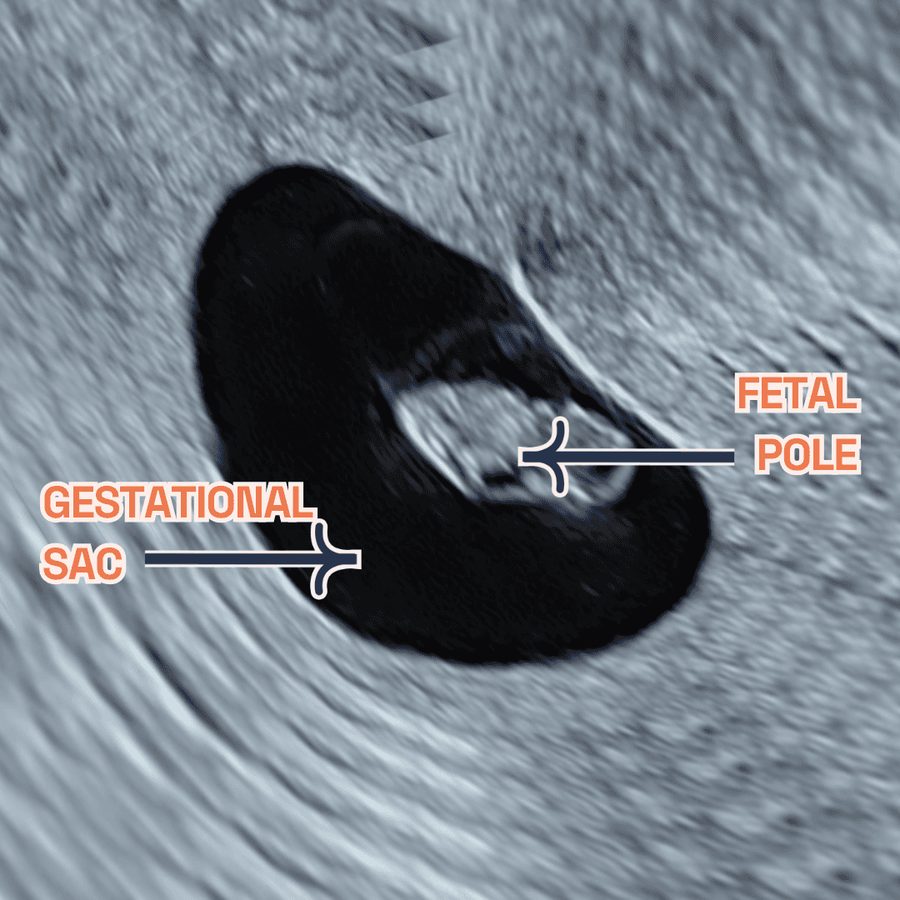
A scan shortly before sampling checks that tissue is still present in the womb. It can also reveal a twin or 'vanished twin', whose DNA could confuse the result, or a possible ectopic or molar pregnancy, which the research studies left out. There is no formal guideline on this scan yet; the advice follows how those studies were run.

The miscarriage should already be confirmed by national scan criteria, which can mean a repeat scan; see no heartbeat on scan.

Ultrasound of an early pregnancy, marked to show the gestational sac and the fetal pole
A scan near the time of sampling shows whether pregnancy tissue remains in the womb

The process

From decision to result

1

Decide whether to test

Think through what the result could and could not tell you, and whether you want to be told the pregnancy's chromosomal sex, which a report may include. Deciding against testing is a perfectly reasonable choice, and a genetic counsellor can help you weigh it up.

2

Scan, then sample

An ultrasound confirms that tissue is still in the womb. Blood is then drawn from your arm, like any routine blood test.

3

Treatment goes ahead

Waiting, tablets or surgery continue as planned. If you are having surgery, ask about keeping the tissue fresh as a back-up.

4

Laboratory and result

The laboratory checks the level of placental DNA, then counts each chromosome. Turnaround varies, so ask in advance, and ideally have a genetics professional, such as one of our genetic counsellors, explain the result to you.

Accuracy

How reliable is the result?

Accuracy is judged against testing of tissue from the same miscarriage. Sensitivity tells you what proportion of the tissue's chromosome changes the blood test also detects; specificity, what proportion of chromosomally normal pregnancies it correctly reports as normal.

A 2025 review of 8 studies (552 miscarriages) found pooled sensitivity of 78 in 100 and specificity of 91 in 100. That leaves out triploidy, which the methods could not see; counting it, sensitivity drops to about 72 in 100. Overall, about 4 in 100 samples gave no result, although one early study reported 27 in 100, particularly in losses before 8 weeks.

Single studies vary: 85 in 100 in an earlier report from the same Danish research, which checked accuracy in 333 women and gave no clear answer for roughly 1 in 9 of all 1,000 women tested, and 59 in 100 in a smaller UK study by Colley and colleagues at Tommy's National Centre for Miscarriage Research. The review's authors judge accuracy after miscarriage to be lower than in ongoing pregnancies, and suited to screening.

In practice

What those figures mean for 100 people tested

Based on the 2025 review, where about 61 in 100 tested miscarriages had a chromosome change. Figures are rounded and leave out samples with no result. They also leave out triploidy, which the test cannot see, so the true number missed is a little higher.

61 pregnancies out of 100 with a chromosome change in the tissue
About 48 of those 61 flagged correctly by the blood test, with about 13 missed
3 to 4 of the 39 with normal chromosomes wrongly flagged as abnormal
93 in 100 chance of a chromosome change when the blood result is abnormal (review estimate)
28 in 100 chance of a chromosome change despite a normal blood result (review estimate)

Detection

Which chromosome changes the blood test can and cannot pick up

For the counting methods used in published miscarriage studies. The middle column is each type's rough share of abnormal tissue results.

Type of changeShare of abnormal resultsPicked up by the blood test?
Extra copy of one chromosome (trisomy)The most common, about half to two-thirdsUsually. This is what the test is built to find.
One X chromosome instead of two sex chromosomes (monosomy X)About 11 to 15 in 100Can be found, but the result may come from the placenta only, or from some of the mother's cells.
Extra whole set of chromosomes (triploidy)Roughly 1 in 10 to 1 in 5, with the rarer tetraploidyNo, not by counting. Some SNP-based tests, which compare DNA 'spelling' differences, can find certain types, but this has only been shown in a small study of ongoing pregnancies.
Large missing or extra piece of a chromosomeAbout 1 in 20Sometimes. One US study missed pieces smaller than about 7 million DNA letters.
Small missing or extra pieceFound by microarray in an extra 5 to 7 in every 100 miscarriagesNo, they are too small to detect.

Also not detected: balanced rearrangements (nothing missing or extra), uniparental disomy (both copies of a chromosome from one parent) and single-gene changes. Mosaicism, a mix of normal and abnormal cells, may be missed.

Advantages

What a blood sample offers that tissue cannot

No tissue to collect

In the Danish research, roughly a third of the first 333 women could not provide tissue, or provided a sample that was probably their own. Tommy's adds that, in UK practice, tissue testing is often limited to people who had surgery.

Fits any choice of treatment

Drawn before the pregnancy passes, the sample leaves you free to wait, take tablets or have surgery for your own reasons.

Works if the pregnancy passes at home

Collecting tissue at home can be difficult and distressing. A sample taken beforehand does not depend on it.

Avoids a common tissue problem

Tissue sent for testing sometimes turns out to be the mother's own cells. In one US study, the blood test found a trisomy where the tissue result had failed for this reason.

Limitations

The drawbacks to weigh up

  • It is time-sensitive, working best before the pregnancy passes and becoming less reliable within a day of it passing.
  • It misses roughly one in five of the chromosome changes that tissue testing finds, or nearer one in four once triploidy is counted.
  • Some samples give no result, and this is more likely in very early losses.
  • With counting methods, triploidy goes unseen, as do balanced rearrangements, small changes and single-gene conditions.
  • Results reflect the placenta, and occasionally your own DNA or, very rarely, an undiagnosed cancer, so unexpected findings need review by a genetics specialist.
  • An abnormal result is strongly suggestive rather than definitive, and a normal one leaves a chromosomal cause possible.
  • After recurrent miscarriage, a falsely abnormal result could stop other causes being looked for.
  • Outside research it is arranged privately, not through the NHS, and the main studies left out ectopic and molar pregnancies and pregnancies whose location was unknown.

Alternatives

When testing the tissue makes more sense

Tissue testing, usually by chromosomal microarray, is the benchmark for the blood test and the route the NHS uses. It picks up smaller changes, and SNP-based arrays can also identify triploidy and show whether a sample is really maternal tissue. It may suit you better in these situations.

  • You are having surgery, so tissue can be sent fresh rather than in a preservative such as formalin.
  • You have had several miscarriages and a detailed result could show whether to check both partners' chromosomes (parental chromosome testing).
  • The loss was in the second trimester, when UK guidance offers tissue testing, while most blood test research involved earlier losses.
  • A blood sample gave no result or a puzzling one, and tissue is still available.
  • A molar pregnancy is suspected, a situation the blood test studies excluded.

The two are not either-or: a sample drawn before treatment leaves tissue testing open. Compare them in blood test or tissue test, or see pregnancy tissue testing.

Your options

Getting a blood test: NHS, research and private routes

Diagnosis, treatment and aftercare can stay with your NHS early pregnancy unit, whatever you decide about testing. NHS genetic testing uses tissue, usually from the third miscarriage onwards or after any loss in the second trimester; the blood test is not yet part of it.

A study at Tommy's National Centre for Miscarriage Research, which began in 2021, is comparing blood and tissue results from 350 women with a missed or incomplete miscarriage. The hope is that a validated test could give answers in days rather than the weeks or months tissue results can take.

If you are considering a private test, ask whether the method was validated for pregnancy loss, how often it fails and whether it detects triploidy. We do not currently offer a blood test after miscarriage ourselves.

What we can do is talk it through with you. By video, our genetic counsellors can help you judge whether a blood test fits your circumstances and how it would sit alongside your treatment, and can explain a result once you have one. The appointments are listed in the next section.

Support is also available from Miscarriage UK on 0303 003 6464 and from Tommy's on 0800 0147 800.

How we can help

Support from our team while you decide

We work alongside the care your NHS early pregnancy unit provides, and you do not need a referral. Scans take place at our City or West London clinic. London Miscarriage Clinic is part of London Pregnancy Clinic, so booking opens on the London Pregnancy Clinic website. If time is short, call us or send us a WhatsApp message.

Online, 30 minutes

Genetic counselling

A video appointment with a registered genetic counsellor. Before a sample, it covers whether a blood test is realistic at your stage, how the scan and timing would work, and what an abnormal, normal or failed result would mean. Afterwards, it can help you read the report and decide whether tissue testing or checking parents' chromosomes would add anything. There is also a longer 60-minute appointment.

6–9 weeks · City or West

Repeat early scan

If the diagnosis is not yet certain, national guidance calls for a repeat scan at least 7 days later. Booked as our viability scan, it is carried out at either clinic by our fetal medicine doctors or specialist sonographers, and you receive a written report. The scan also shows whether pregnancy tissue is still in the womb, which matters if you are thinking about a blood test.

From around 10 weeks · City

Second-opinion scan

If you would like the diagnosis checked before deciding on treatment or testing, Dr Fred Ushakov can carry out an independent scan at our City clinic, form his own view, talk you through what he finds and provide a written report the same day. Your early pregnancy unit continues to manage your care.

Doctor-led, by enquiry

Clinical genetics consultation

If a result is unexpected or hard to interpret, such as a finding that may come from your own cells, or a missing or extra piece of a chromosome, our Consultant in Clinical Genetics, Dr Harry Leitch, can review the report alongside your history and advise on next steps. In many cases the appointment can be held online. It is arranged by enquiry.

Common questions about the blood test

Can the test be done very early, at around 6 weeks?

It can be, as research has included losses from about 5 weeks. The chance of no result is higher in very early losses, though, because there is less placental DNA. In the Danish research, a higher level of the pregnancy hormone hCG made a conclusive result more likely.

Does it matter if I was carrying twins?

Yes, so mention it. DNA from a second pregnancy, including a twin that stopped developing earlier (a 'vanished twin'), can mix into the sample and mislead. The scan before sampling helps to spot this.

What happens after an abnormal blood result?

It depends on the finding. A trisomy usually arises by chance while an egg or sperm is forming, and rarely points to a chromosome problem in either partner. If part of a chromosome appears missing or extra, further tests, sometimes of both parents, may be advised, and any tissue available can confirm the result. See understanding your result; our genetic counsellors can also go through it with you.

Could the blood test reveal something about my own health?

Rarely. Most of the DNA in the sample is yours, so a result can occasionally reflect a chromosome difference in some of your own cells, such as cells with a single X chromosome (which become more common with age), or, very rarely, an undiagnosed cancer. A genetics specialist should review any unexpected finding.

Does a normal blood result mean there was no genetic cause?

Not necessarily. The 2025 review estimated about a 28 in 100 chance of a chromosome change even after a normal result, and some changes are invisible to the test. After recurrent miscarriage, tests for antiphospholipid syndrome and thyroid problems and a scan of the womb's shape are usually advised whatever the result; see recurrent miscarriage.

Can I see you without a referral from my GP or hospital?

Yes. You can book an online genetic counselling appointment or a scan yourself, or ring us on 020 3687 2939 if you are unsure which appointment fits. Do keep your early pregnancy unit informed, as they will usually be looking after your treatment and aftercare.

About this information

Nothing on this page replaces advice from the people looking after you, and reading it is not a recommendation to have any particular test. Heavy bleeding, strong pain, a temperature or faintness need attention without delay: contact your early pregnancy unit or NHS 111, and in an emergency, dial 999.

Contact

Questions about a blood test after miscarriage?

Send us an enquiry

Let us know whether the miscarriage has been confirmed and whether a treatment date is set; for anything time-critical, please call. Not for emergencies: for heavy bleeding, severe pain or feeling faint, call 999.

For urgent matters please call 020 3687 2939.

Sources & clinical references

The figures and clinical statements on this page are drawn from the sources below. Guidance evolves — always discuss your individual circumstances with a clinician.

  1. Prenatal Diagnosis (Pauta et al.)Genome-wide cell-free DNA analysis for aneuploidy detection in miscarriages: test performance meta-analysis2025
  2. The Lancet (Schlaikjaer Hartwig et al.)Cell-free fetal DNA for genetic evaluation in Copenhagen Pregnancy Loss Study (COPL): a prospective cohort study2023
  3. Human Reproduction (El Sammaa-Aru et al.)How big is the time window for cell-free fetal DNA testing after pregnancy loss and which factors are associated with a successful result?2026
  4. Human Reproduction (Yaron et al.)Maternal plasma genome-wide cell-free DNA can detect fetal aneuploidy in early and recurrent pregnancy loss and can be used to direct further workup2020
  5. Journal of Clinical Medicine (Colley et al.)Cell-free DNA in the investigation of miscarriage2020
  6. Journal of Clinical Medicine (Kutteh et al.)Cell-free DNA analysis of fetal aneuploidies in early pregnancy loss2024
  7. Genes (Bedei et al.)Chances and challenges of new genetic screening technologies (NIPT) in prenatal medicine from a clinical perspective: a narrative review2021
  8. Fetal Diagnosis and Therapy (Nicolaides et al.)Prenatal detection of fetal triploidy from cell-free DNA testing in maternal blood2014
  9. RCOGRecurrent Miscarriage (Green-top Guideline No. 17)2023
  10. GOV.UK (NHS fetal anomaly screening programme)Screening tests for you and your baby: Down's syndrome, Edwards' syndrome and Patau's syndrome2026
  11. Tommy'sUsing fetal DNA to detect chromosomal abnormalities following miscarriageAccessed October 2026
  12. NICEEctopic pregnancy and miscarriage: diagnosis and initial management (NG126)2026