
Internal scan
The sonographer looks for a heartbeat, then an embryo. If neither is seen, the sac is measured.
Anembryonic pregnancy
Blighted ovum
An anembryonic pregnancy, still often called a blighted ovum, is when a pregnancy sac forms in the womb but no embryo develops inside it, or one stops growing too early to be seen. Our team explains how it is confirmed, what usually lies behind it and which tests may still be possible.
No single scan should settle this on its own. A sac under 25 mm, or a scan done only through the tummy, always needs a repeat scan; a larger sac needs a second opinion, a repeat scan or both. If you would like the pregnancy tested, the timing of treatment matters too.
In brief
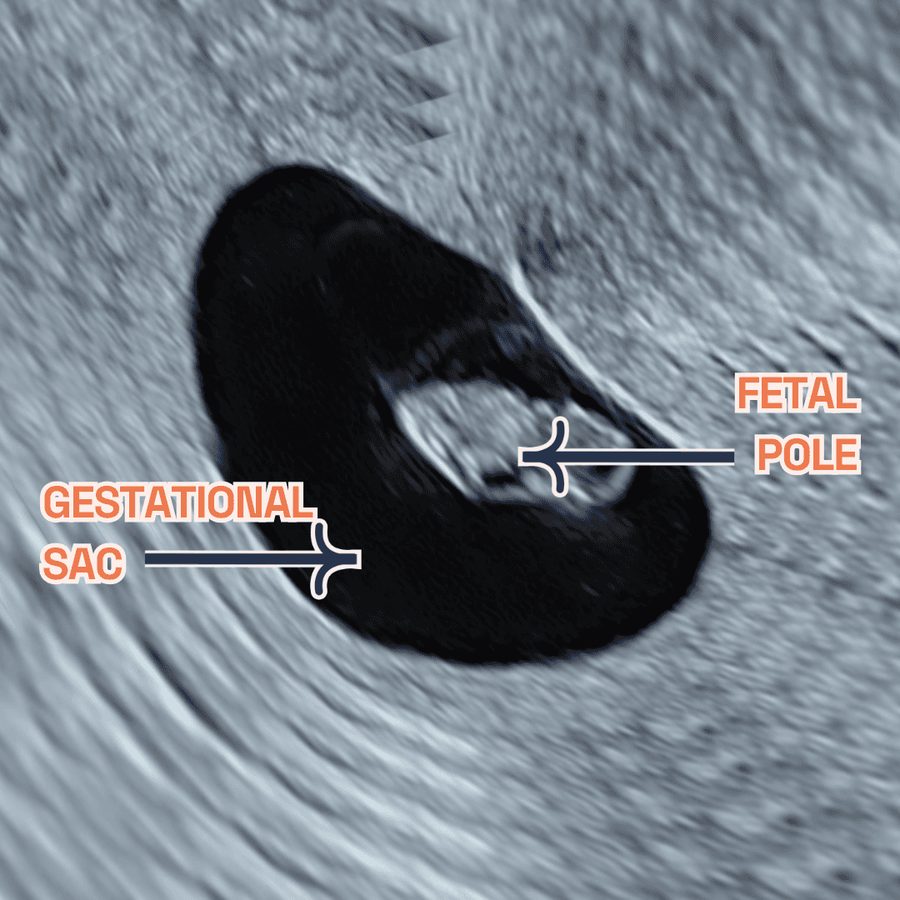
Early in pregnancy, a small fluid-filled sac, called the gestational sac, forms in the womb. On a scan the embryo normally appears inside it as a small thickening known as the fetal pole. In an anembryonic pregnancy the sac forms and keeps growing, but the embryo never develops, or stops so early that it is reabsorbed and cannot be seen.
Because the sac and early placental tissue can go on growing for a while, and pregnancy hormones can stay high, you may still feel pregnant until a scan shows otherwise. Miscarriage UK notes that it is most often found between about 8 and 13 weeks. It is one form of missed, or silent, miscarriage, and the likeliest cause is a chance problem in very early development, often a chromosome error, not anything you did.
Words you might see
Scan reports and hospital letters often use several different words for the same finding. Here is what each of the common ones means.
| Term | What it means |
|---|---|
| Gestational sac | The fluid-filled sac in the womb in which an embryo normally develops. |
| Fetal pole | The first visible sign of the embryo on a scan. 'No fetal pole' means no embryo can be seen. |
| Yolk sac | A small round structure that can be seen inside the sac in early pregnancy. A sac holding a yolk sac but no embryo can also be classed as anembryonic. |
| Mean sac diameter (MSD) | The sac's average diameter, worked out from its measurements. When no embryo is visible, it helps decide what must happen before a diagnosis can be made. |
| Anembryonic pregnancy | A pregnancy in which the sac developed but the embryo did not, or stopped too early to be seen. |
| Blighted ovum | An older name for the same thing, still widely used in hospitals, although many people find it upsetting and confusing. |
| Products of conception (POC) | Medical wording for pregnancy tissue, such as the sac and early placenta, whether still in the womb or already passed. It often appears in the names of tissue tests. |
Diagnosis
An internal (transvaginal) scan gives the clearest view in early pregnancy. NICE, whose guidance NHS services in England follow, asks the person scanning to look for a heartbeat, then an embryo, and to measure the sac only if no embryo is seen. Staff should also tell you that no single scan is 100% certain, particularly in the earliest weeks.
Dates worked out from your last period are not reliable enough on their own to say that an embryo should already be visible, because cycle lengths vary. Waiting for a repeat scan is hard, but NICE states that the wait does not harm the pregnancy.
Step by step
The sonographer looks for a heartbeat, then an embryo. If neither is seen, the sac is measured.
No diagnosis yet. A repeat scan follows at least 7 days later, occasionally with a further scan after that.
A second specialist reviews the findings, a repeat scan is done at least 7 days later, or both.
The sac size is recorded and the repeat scan is at least 14 days later.
Your early pregnancy unit explains the options for managing the miscarriage. You can ask about genetic testing before anything is done.
What testing shows
Tissue from anembryonic pregnancies shows chromosome changes about as often as tissue from losses where an embryo had been seen. Both studies below used older, culture-based methods, so treat the figures as a guide only.
Causes
Guidance from the Royal College of Obstetricians and Gynaecologists (RCOG) describes one-off early miscarriages as often caused by random chromosome changes in the pregnancy. The commonest is a trisomy, an extra copy of one chromosome, which usually arises as the egg develops and becomes more likely as the egg gets older.
In the larger study above, empty-sac pregnancies less often had triploidy (a whole extra set of chromosomes) or sex-chromosome changes, and more often had tetraploidy (two extra sets), than losses where an embryo was seen. The tetraploidy difference held when the authors rechecked some samples on uncultured tissue.
Roughly 4 in 10 empty-sac pregnancies in that study had no change the method could see. The authors suggest some of these may involve changes too small for older tests, or faults in single genes or in how genes are switched on and off.
Ordinary exercise, sex and work are not known causes. Was it something I did? covers the evidence on lifestyle, and chromosomal and genetic causes explains the main types of change.
Genetic testing
It can be. Chromosomes can be read from placental tissue as well as from an embryo, and which route is open to you depends mainly on whether the sac is still in the womb. Our genetic counsellors can help you work out which one applies to you.
Fragments of DNA from the early placenta circulate in your bloodstream. By measuring how much of this DNA comes from each chromosome, a laboratory can spot one that is extra or missing, the principle NIPT uses in ongoing pregnancies. Because the DNA is placental, an empty sac does not rule the test out. In a small study of 9 women with an anembryonic pregnancy, placental DNA levels could be measured in 5, and were similar to those in normal early pregnancies.
One of the largest studies so far, of 1,000 women in Denmark, included empty-sac pregnancies. Across all types of loss, the blood test found 85 in 100 of the changes seen in tissue, and about 1 in 9 results were inconclusive; pooled across 8 studies, the figure was about 78 in 100. Counting-based tests cannot detect extra whole sets of chromosomes, such as triploidy or tetraploidy. An abnormal result is a screening finding, not a diagnosis, and a normal one does not rule a chromosome change out.
The test is not standard NHS care, and UK research funded by Tommy's is still assessing it. Timing matters too: in the Danish group's later analysis, roughly 9 in 100 samples gave no result while tissue was still in the womb, against 27 in 100 drawn between 12 and 24 hours after the tissue had passed. See testing before a miscarriage completes.
Thinking about a blood test? A session with one of our genetic counsellors can help you judge whether it is likely to add anything in your situation, and what its limits would mean for you.
Laboratories normally test the chorionic villi, which are early placental tissue, not the embryo. In both studies above this tissue gave results whether or not an embryo had developed. The sample has to be sent fresh. Formalin, the preservative used when tissue goes for routine microscope examination, usually makes it unsuitable, so testing has to be planned before any procedure.
The NHS usually offers tissue testing from the third miscarriage. According to Tommy's, in practice it is often limited to tissue removed during surgery, and a result can take weeks or months to arrive. In the Danish study, roughly a third of women either could not collect the pregnancy tissue or collected tissue likely to be their own. See pregnancy tissue testing.
Private tissue testing is not booked online with us. It is arranged through our genetic counsellors, so the earlier you speak to them, the more likely it is that the sample can be collected in the right way.
Pregnancy tissue is often mixed with the mother's cells. If those are tested by mistake, the result looks like a normal female pregnancy (46,XX). The US study found more 46,XX than 46,XY results in both groups, which its authors read as a sign of this contamination.
RCOG notes that a SNP-based microarray can tell the pregnancy's DNA from the mother's, and a laboratory may ask for a sample of your blood to check. If you receive a 46,XX result, ask how contamination was ruled out. Understanding your result explains other result types.
Your situation
A rough guide only. Your early pregnancy unit, or one of our genetic counsellors, can tell you what applies in your case.
A blood test may still be possible, ideally before any tablets or procedure. Tissue testing can also be planned.
Before treatment starts, say you would like the pregnancy tested and ask how tissue will be collected without preservative.
A blood test becomes less reliable in the hours after tissue passes. If tissue was kept without preservative, ask your unit promptly whether it can be sent.
Next steps depend on your history. After repeated losses, testing both parents may be offered in specific circumstances. See parental chromosome testing.
Practical steps
These points are far easier to settle before the miscarriage is managed than afterwards.
Tell the early pregnancy unit you would like the pregnancy tested, and ask whether the NHS can do this for you.
Ask whether tissue will go for genetic testing or only for routine examination in formalin.
If you are considering a private blood test, have it before tablets or a procedure, after a scan confirms the sac is still in place.
Ask for copies of your scan reports, including the sac measurements and dates.
Mention any previous miscarriages, because this can change what the NHS offers.
If you are not sure testing is worthwhile, talk it through before treatment rather than after. You can book a video appointment with one of our genetic counsellors.
What happens next
Miscarriage UK explains that an empty sac can be left to come away naturally, which may take time while hormone levels fall, or the process can be helped with medication or surgery. Unless you need emergency care, you should usually be able to choose, although your history or local services may limit the options.
In a UK study of 92 women with an empty sac who chose to wait, about 1 in 4 miscarried naturally within a week of diagnosis, about half within two weeks and around two-thirds by the end of follow-up, which lasted up to about six weeks; the others were offered surgery. Just diagnosed compares the options.
Looking ahead
It can, but it is not likely. Miscarriage UK describes anembryonic pregnancy as a chance event and says most women go on to have a healthy pregnancy. RCOG guidance notes that when a miscarriage is found to have a chromosome change, the outlook for the following pregnancy tends to be better than after a loss whose chromosomes were normal, comparing women of the same age.
In the UK, recurrent miscarriage means three or more losses, which is usually when the NHS starts investigations. RCOG lets doctors begin after two if they suspect an underlying cause, for example when an earlier loss had normal chromosomes. See recurrent miscarriage and preparing for your next pregnancy.
Some people feel they should not be so upset because no embryo was ever seen. You were pregnant, and may already have been picturing a future with this baby, so the grief can be just as real.
NHS care and support
Your NHS early pregnancy unit is the place to start for repeat scans, choices about managing the miscarriage and questions about NHS tissue testing. If you are unsure about the diagnosis, you can ask the unit for a second opinion.
If you need to talk, Miscarriage UK runs a support line (0303 003 6464), and Tommy's has a free midwife-led line on 0800 0147 800.
Some people also want a further scan, a second specialist view or advice on genetic testing outside the NHS. Our team can help with these alongside your NHS care, as set out below. Whoever arranges a test for you, ask which method the laboratory uses and what you would be offered if the sample gives no result.
How we can help
These appointments take place at our City and West London clinics or by video. No referral is needed, and your early pregnancy unit can go on caring for you at the same time. London Miscarriage Clinic is part of London Pregnancy Clinic, so booking opens on the London Pregnancy Clinic website.
Online, 30 minutes
Ideally held before any tablets or procedure, this video session with one of our registered genetic counsellors looks at whether testing an empty-sac pregnancy is realistic for you, which sample would be used and what a result could and could not explain. If you want private tissue testing, this is where it starts; it cannot be booked online on its own.
6–9 weeks
If your sac measured under 25 mm, nothing is certain until it has been scanned again. One of our fetal medicine doctors or specialist sonographers can scan you again once enough time has passed (at least 7 days after an internal scan, or 14 days after a tummy-only scan), measure the sac and look for an embryo. Your early pregnancy unit can also repeat it on the NHS.
From around 10 weeks
At 10 weeks or beyond, when the findings felt unclear, Dr Fred Ushakov can scan you independently at our City clinic before you decide on treatment. He reaches his own view first, then looks at your earlier reports. Decisions about treatment stay with your own care team.
After your first period
When the pregnancy has come away, naturally, with tablets or after a procedure, this recovery check after your first period looks at whether your womb has recovered and whether any pregnancy tissue is left. It is a check-up, not a scan for diagnosing a miscarriage.
Sometimes, if the first scan was very early. That is why, on an internal scan, a sac under 25 mm with nothing inside always needs another scan at least a week later before any diagnosis, or at least two weeks later if the scan was only through the tummy. At 25 mm or more, a second specialist opinion, a repeat scan, or both, are needed before the diagnosis is confirmed.
Pregnancy hormones can stay high for some time after development has stopped, so symptoms may carry on. It does not mean the scan was wrong.
The early placental tissue, which is what laboratories normally test after any early miscarriage. While the sac is still in the womb, a blood test can analyse placental DNA in your bloodstream instead. Our page Blood test or tissue test? sets them side by side.
Not usually. Most chromosome errors behind early miscarriages are random events in that one pregnancy. Trisomies become more common as the egg gets older, so age plays a part, but one empty-sac pregnancy does not mean the next will be the same. After several losses, a doctor can advise which investigations are worthwhile for you both.
Usually not after a first or second miscarriage. NHS genetic testing of pregnancy tissue is generally offered from the third miscarriage, or earlier when something about the loss points to a chromosome condition. Tissue examined under a microscope after surgery is a different test that does not look at chromosomes.
Yes. Our scans and online genetic counselling sessions are self-referral, so you can book them yourself. Keep any earlier scan reports to hand, so whoever sees you knows what has already been measured. If you have urgent symptoms, or need decisions about managing the miscarriage itself, keep in touch with your NHS early pregnancy unit as well.
This page gives general information about a common scan finding. It is no substitute for personal advice from the clinicians looking after you, including our own team, who would need to see your scans and know your history first. Heavy bleeding, severe pain, a high temperature or feeling faint need prompt help: contact your early pregnancy unit or NHS 111, and dial 999 in an emergency.
Contact
The figures and clinical statements on this page are drawn from the sources below. Guidance evolves — always discuss your individual circumstances with a clinician.