
Removed during a procedure
The team collects the tissue. Ask beforehand for a fresh sample to go to the genetics laboratory, alongside any sample sent for examination under the microscope.
After a miscarriage, the pregnancy tissue itself can sometimes be tested to find out whether a chromosome change was involved. Whether that is possible depends on how the miscarriage happens, how the tissue is handled and, on the NHS, how many losses you have had.
Below we explain when tissue can be collected, which laboratory methods are used, how to keep a sample usable, why some tests give no answer, and what is still possible if there is nothing to test. Testing is always your choice, and our genetic counsellors can help you decide.
The basics
Tissue testing looks at the chromosomes of the pregnancy itself, not those of either parent. The sample is usually tissue from the early placenta, known as chorionic villi. Doctors and laboratories often call this products of conception, or POC, testing.
Chromosomes are the packages that carry a pregnancy's genetic instructions. Chromosome changes in the pregnancy account for around half of early miscarriages. They include an extra or missing chromosome, a whole extra set and a rearranged piece. These changes usually arise by chance when an egg or sperm is made, or just after fertilisation. Our page on chromosomal causes of miscarriage explains the main types.
Testing the tissue is the most direct way to find out whether that applied to your pregnancy. A result can offer an explanation, help with planning a future pregnancy and show whether either parent needs a chromosome test of their own. It can't always give an answer: some samples fail, and a normal result leaves other causes open. We would rather you knew both sides before deciding.
When it's possible
It depends mostly on how the miscarriage is managed and what happens to the tissue afterwards. Choose the treatment that is right for you; testing can often be planned around it, especially if you raise it before treatment begins.
The team collects the tissue. Ask beforehand for a fresh sample to go to the genetics laboratory, alongside any sample sent for examination under the microscope.
Tissue can only be tested if it is saved. The charity Tommy's suggests keeping it cool and asking your early pregnancy unit, midwife or GP what to do next.
The hospital team can take small samples, for example from the placenta, umbilical cord or skin, and may offer a post-mortem examination, which only happens if you agree.
Tissue that was flushed away, couldn't be found or was put in formalin preservative usually can't be used by NHS genetics laboratories. See what can still be done.
NHS criteria
England's NHS genetic tests each have a code in the National Genomic Test Directory, matched to the reason for testing. Scotland, Wales and Northern Ireland have their own arrangements, and local practice varies, so check with your early pregnancy unit. If you don't meet these criteria, testing can still be arranged privately.
| Your situation | What may be offered | Where this comes from |
|---|---|---|
| Your third miscarriage or any after it, with tissue to test | A quick check for the commonest chromosome changes, plus a genome-wide chromosomal microarray | NHS code R318; RCOG guideline (2023) |
| Any miscarriage in the second trimester | Chromosome testing of the pregnancy tissue | RCOG guideline (2023); arrangements vary by hospital |
| One miscarriage with other features that suggest a chromosome condition | Chromosome testing of the tissue | NHS code R22 |
| A first or second early miscarriage without such features | Usually no NHS tissue testing; it can be arranged privately, for example through our genetic counsellors | RCOG guideline (2023); ESHRE guideline (2023) |
| Three or more losses, the tissue test failed and no earlier loss has a result; or five or more losses, none of them tested | A chromosome test (karyotype) for both parents from a blood sample | NHS code R464 |
| The tissue showed an unbalanced rearrangement | Chromosome tests for both parents, with referral to a genetics team if one carries a balanced form | RCOG guideline (2023); NHS code R465 |
ESHRE, the European society, does not recommend routine tissue testing but accepts it can be done to explain why a loss happened; where it is done, it favours an array over traditional karyotyping.
In the laboratory
These tests measure the amount and arrangement of chromosome material. None reads every gene letter by letter. Knowing which method a laboratory uses helps you understand what a result can and cannot tell you.
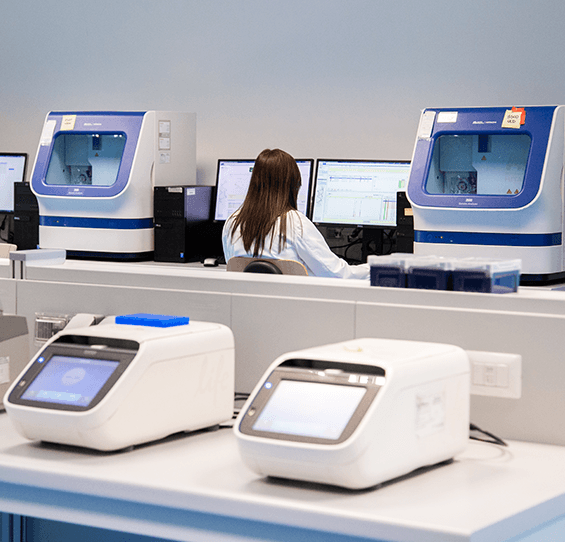
QF-PCR (quantitative fluorescent PCR) is a rapid DNA test that counts copies of chromosomes 13, 18 and 21 and the sex chromosomes, and can pick up triploidy, a whole extra set. It copes with small or poor-quality samples and can show whether the mother's cells are mixed in. Changes on other chromosomes, small missing or extra pieces and balanced rearrangements are outside its view.
A microarray measures chromosome material across the whole genome, finding extra or missing chromosomes and much smaller missing or extra pieces. It works on extracted DNA, so the cells don't need to grow. It picks up small changes that karyotyping would miss in another 5 to 7 in 100 miscarriages, though not all of these explain the loss.
The NHS uses a SNP array, which reads small DNA differences between people. That lets it detect triploidy and, because it can show which parent the chromosomes came from, check whether the sample is mostly the mother's own cells. No microarray can see a balanced rearrangement, where nothing is missing or extra.
Karyotyping grows cells from the tissue, then stains and arranges the chromosomes under a microscope. It shows balanced as well as unbalanced rearrangements, but only large changes. Because it needs living, dividing cells, it often fails with miscarriage tissue, so NHS testing of miscarriage tissue relies on QF-PCR and microarray, keeping karyotyping for questions such as whether a parent carries a balanced rearrangement.
| Feature | QF-PCR | SNP microarray | Karyotype by culture |
|---|---|---|---|
| Needs living cells | No | No | Yes |
| What it covers | Chromosomes 13, 18, 21, X and Y | The whole genome | The whole genome |
| Smallest change it can see | Whole extra or missing chromosomes | About 50–200 kb | About 5 Mb |
| Triploidy (an extra set) | Yes | Yes | Yes |
| Spots the mother's cells mixed in | Yes, down to about 1 in 10 cells | Yes | No, and may report them as a normal female result |
| Balanced rearrangements | No | No | Yes |
| Main drawback | Narrow view | Misses balanced changes; may find changes of uncertain meaning | Cultures often fail with miscarriage tissue |
kb means a thousand DNA letters and Mb a million. Exact coverage varies between laboratories.
Handling the sample
Let the early pregnancy unit know as soon as you can that you want the tissue tested, and check whether you meet NHS criteria. If you plan to test privately with us, speak to one of our genetic counsellors before treatment too. Arrangements are far easier to make beforehand.
Tissue for genetic testing should be fresh, dry in a sterile pot or in a little sterile saline. Formalin, the preservative used for microscope examination, makes a sample unsuitable for NHS genetics laboratories.
Save what you can in a clean container and keep it cool. Don't freeze it unless the laboratory advises you to. Ask your early pregnancy unit, midwife or GP where to take it. If bleeding is heavy, get help first.
Delay makes culture failure more likely. Staff may gently rinse the tissue in saline to reduce contamination with the mother's blood.
If no recognisable pregnancy tissue is seen, the laboratory may request some of your blood to check whether the tissue is actually yours.
You will be asked to agree to the test. The laboratory only needs a small piece; anything left over is handled according to your recorded wishes or disposed of sensitively, so tell the team what you would like.
Before treatment
If testing matters to you, ask the team treating you these questions before treatment starts. Writing the answers down can help on a difficult day, and they are useful to bring to a genetic counselling appointment with us.
Do I meet the criteria for NHS testing, and if not, could a fresh sample be kept aside so I can arrange testing privately?
Will a sample go to the genetics laboratory without formalin, even if another goes for microscope examination?
If I pass tissue at home, what container should I use, how should I store it and where do I bring it?
Who will give me the result, and how will I hear?
What will happen to any tissue left over, and can I make my own arrangements for it?
These figures come from the guidelines and studies listed under sources. Your own chance of a result depends on the sample and the laboratory.
Limitations
The sample may hold too little pregnancy tissue, may have been preserved, or its cells may not grow. Sometimes the tissue is entirely the mother's, and no result is possible.
With karyotyping, a 'normal female' (46,XX) result can mean the laboratory tested the mother's cells. A SNP array, QF-PCR or a comparison with your own blood sample can show whether this has happened.
A low-level mix of cells with different chromosome patterns can be missed. Because the tissue tested is often placental, a change may be present in the placenta but not the embryo, or the reverse.
Single-gene changes and very small missing or extra pieces fall below the resolution of these tests, so a normal result does not exclude every genetic cause.
A microarray can find a small change whose significance isn't yet known. It might have no bearing on the miscarriage; a genetics professional can explain whether it matters.
No chromosome change was found in the sample. The cause may lie elsewhere, such as antiphospholipid syndrome, a thyroid condition or the shape of the womb, which are checked separately after recurrent miscarriage. Often, though, no cause is found.
No sample
Having nothing to test is common, and it is not a failing on your part: in the Danish study above, about a third of women could not collect a usable sample. Our genetic counsellors can go through which other routes may be open to you.
If the pregnancy has not yet passed, a blood test may be an alternative. It analyses placental DNA in your blood, so it is done while pregnancy tissue is still in the womb, ideally confirmed by a scan shortly before the sample. See blood-based genetic testing and choosing between a blood test and a tissue test.
A blood test is not part of standard NHS miscarriage care, and it is not as complete as testing tissue. In the Danish study, it picked up about 85 in 100 of the chromosome changes found in the tissue, and about 1 in 9 tests gave no clear result.
When several losses have gone untested, a blood test of both partners' chromosomes may be offered instead. NHS criteria are narrow and NHS guidance notes it tells you less than testing a pregnancy; RCOG guidance is broader. Parental chromosome testing explains who it helps.
NHS guidance calls testing any future loss the most informative route, so if you are pregnant again, it can help to know in advance how tissue would be collected and who to call. The wider tests after recurrent miscarriage, such as checks for antiphospholipid syndrome and thyroid function and a scan of the womb, don't depend on having tissue.
Results
A chromosome change such as a trisomy (one chromosome present three times instead of twice) usually means the miscarriage happened by chance and does not point to a problem in either parent. According to the RCOG guideline, a miscarriage with a chromosome change is linked to a better outlook in a future pregnancy than one with normal chromosomes, when women of a similar age are compared.
Some results lead to further steps. An unbalanced rearrangement means both parents should be offered their own chromosome test. Triploidy in which the extra set came from the father can indicate a partial molar pregnancy, which needs follow-up hCG blood or urine tests. A finding of uncertain meaning may need a genetics opinion. What your result means goes through each type.
Our genetic counsellors can go through a tissue result with you, whether the test was done on the NHS or privately, and talk about what it could mean for a future pregnancy.
Arranging testing
On the NHS, tissue testing is arranged by the team managing your miscarriage, usually the early pregnancy unit, or by a recurrent miscarriage clinic, which NHS genetics guidance advises after repeated losses. If a result shows a genetic cause, referral to a clinical genetics team may be suggested.
If you are not eligible on the NHS, or would like testing after a first or second loss, it can be arranged privately. There is no online booking for the tissue test itself; the first step with us is a video appointment with one of our registered genetic counsellors, who looks at whether testing makes sense for you and explains how a fresh sample would need to be collected, stored and sent. The questions above are worth asking wherever you have testing.
If a result needs a doctor's view, for example an unusual rearrangement or a finding of uncertain meaning, Dr Harry Leitch, Consultant in Clinical Genetics, can review it with you.
Support is there whether or not you choose testing. For emotional support, you can call the Miscarriage UK helpline (0303 003 6464) or speak to a Tommy's midwife free on 0800 0147 800.
How we can help
Whether you are planning ahead of treatment or already have a result, these are the appointments that fit most closely. You can book without a referral, and your NHS care carries on alongside. London Miscarriage Clinic is part of London Pregnancy Clinic, so booking opens on the London Pregnancy Clinic website. If you are not sure which fits, call us on 020 3687 2939.
Online, 30 minutes
The first step for private tissue testing, which is arranged here rather than booked online. By video, one of our registered genetic counsellors covers whether testing suits you, how a fresh sample must be kept out of formalin and what a result could and could not show, or explains a result you already have. A 60-minute appointment (£140) leaves more time for a complex history.
Only when indicated
A blood test that checks one or both parents for a balanced rearrangement. It is most useful when pregnancy tissue showed an unbalanced rearrangement, or after repeated losses when no tissue result could be obtained, so we suggest talking to a genetic counsellor first. Testing both partners costs £550.
Doctor-led, by enquiry
When a tissue result shows a rearrangement, mosaicism or a finding of uncertain meaning, or several losses show a pattern, Dr Harry Leitch, Consultant in Clinical Genetics, can look at the reports with you and advise whether further testing for you or your family would help. Appointments are arranged by enquiry.
After repeated losses
A normal tissue result leaves other causes worth checking. This assessment with a consultant gynaecologist at our City clinic includes a pelvic scan and blood tests for antiphospholipid syndrome and thyroid function. You book with a £300 deposit, which comes off the package price; chromosome tests are separate.
FAQs
Usually not on the NHS. Tissue sent for microscope examination is normally preserved in formalin, which NHS genetics laboratories treat as unsuitable.
Some specialist laboratories can run a microarray on preserved tissue embedded in wax: in one large US laboratory series, about 86 in 100 such samples gave a result. This is not part of routine NHS testing. If it matters to you, ask whether the tissue was kept and talk it through with a genetics professional first.
Often, yes. QF-PCR and microarray both look at the sex chromosomes, so a report may say whether the pregnancy had XX or XY chromosomes. If you would rather not know, say so before the result is discussed.
It depends on the laboratory and the tests used. NHS England's genomics education service gives target reporting times for the rapid test of 3 to 42 days, depending on the reason for testing, and says a microarray typically takes two to six weeks. Ask who will contact you and how.
Sooner is better, especially if cells need to grow for karyotyping. Guidance from one NHS genetics laboratory allows tissue to be kept overnight in a little sterile saline in a sealed pot; other laboratories' rules may differ. Don't freeze it unless the laboratory advises you to.
Yes. Private testing is available, including after a first or second miscarriage. With us, it starts with an online genetic counselling appointment, where we check that testing suits your situation and explain how the sample must be collected and transported.
Wherever you have it done, ask which methods the laboratory uses (array-based testing is generally preferred to karyotyping alone), whether it checks for the mother's cells, and who will explain the result. Agree the plan with your early pregnancy unit before treatment if you can.
No. You can book an online genetic counselling appointment yourself, or call us on 020 3687 2939. Please also tell your early pregnancy unit what you are planning, especially before treatment, so that a fresh sample can be set aside without formalin.
This page explains general principles and can't take account of your own medical history, so please use it alongside advice from the professionals caring for you. Heavy bleeding, severe pain, a fever or feeling faint all need prompt attention, so get in touch with your early pregnancy unit or NHS 111 straight away. For an emergency, phone 999.
Contact
The figures and clinical statements on this page are drawn from the sources below. Guidance evolves — always discuss your individual circumstances with a clinician.