
Checking Both Partners' Chromosomes After Miscarriage: When It Helps

After a miscarriage there are two separate chromosome questions: what was in the pregnancy, and what is in each parent. Here we explain why the pregnancy is usually tested first, when a blood test for both partners is advised, and what it means if one of you carries a balanced rearrangement.

Most couples never need this test. Only around 3 to 6 in 100 couples who have had recurrent miscarriages turn out to have a rearrangement, and even then the outlook for a healthy baby is good. If you are not sure whether it would help you, our genetic counsellors can talk it through with you first.

Start here

Two different tests: one for the pregnancy, one for each parent

Genetic tests after a miscarriage come in two kinds, aimed at different people. What the first one finds usually tells us whether the second is worth doing.

Usually first

Test one: the pregnancy

Looks at the chromosomes of the pregnancy that was lost. This uses tissue from the miscarriage or, in some situations, a blood sample taken while the pregnancy has not yet passed. About half of early miscarriages show a chromosome change, mostly by chance. See testing pregnancy tissue and the blood test.
Only in some situations

Test two: the parents

Looks at each partner's own chromosomes from an ordinary blood sample, a test called a karyotype. The question is whether one of you has a rearrangement that could make some pregnancies unbalanced. Most people tested have normal chromosomes.

How the two fit together

A chance change in the pregnancy, such as an extra chromosome, is usually no reason to test the parents; an unbalanced rearrangement is. If the pregnancy could not be tested at all, parental testing may be offered instead.

The basics

What a balanced rearrangement is

Most cells carry 46 chromosomes, the tiny structures that carry our genes. In a balanced rearrangement, a piece of chromosome has moved to a new place or turned round, but nothing has been lost or added. Because all the genetic material is still there, a carrier is usually healthy and has no reason to suspect it.

Picture two strings of beads, each from a different pair, that have swapped a short section: each now looks different, but every bead is still there. An egg or sperm receives only one string from each pair, so it can end up with one swapped string but not the other, carrying a few beads too many or too few. The pregnancy is then unbalanced. In couples found through miscarriage this usually ends in miscarriage, most often early; rarely it continues, so testing in pregnancy is offered.

Other eggs or sperm carry the usual arrangement, or the same balanced one as the parent, and either can lead to a healthy baby. The proportions depend on the chromosomes involved, which is why a genetics specialist gives you an estimate for your own result rather than a general figure.

Types

Translocations and inversions: the main types

Reports usually name the type of rearrangement and the chromosomes involved. The right-hand column comes from a Dutch study that followed couples for an average of almost six years after testing, and shows how often they had at least one further miscarriage.

TypeWhat has happenedCouples with a further miscarriage
Reciprocal translocationPieces of two different chromosomes have swapped places.About 54 in 100
InversionA piece of one chromosome has broken off, turned upside down and rejoined.About 49 in 100
Robertsonian translocationOne whole chromosome has joined onto another.About 34 in 100
No rearrangement (for comparison)Couples tested after two or more miscarriages whose chromosomes were normal.About 30 in 100

Figures from Franssen and colleagues (BMJ, 2006), as summarised in RCOG and ESHRE guidance. Most carrier couples in the same study still had a healthy child in the end.

In numbers

How often a parent turns out to be a carrier

Published figures vary, partly because some studies count couples and others count individual parents, and partly because the groups tested differ. RCOG guidance, citing one large database study, notes the chance rises with the number of losses: from about 2 in 100 parents after one miscarriage to about 6 in 100 after three.

3 to 6 in 100 couples with recurrent miscarriages in whom one partner carries a balanced rearrangement
Under 2 in 100 parents with recurrent miscarriage found to carry a translocation in a UK audit of over 20,000 people
Roughly 1 in 3 unbalanced rearrangements found in miscarriage tissue that came from a parent, in one hospital study with small numbers
83 in 100 carrier couples in a Dutch study with at least one healthy child; for non-carriers the figure was 84 in 100

When it does not help

When parental testing is not usually needed

Testing every couple finds little. A UK audit found a translocation in fewer than 2 in 100 parents tested, and RCOG does not consider routine screening good value. It is generally not advised in these situations, and if one of them applies to you, our genetic counsellors will say so rather than suggest a test that is unlikely to help.

  • After a single miscarriage, unless testing of that pregnancy showed an unbalanced rearrangement or either family's history suggests one.
  • When tissue showed an extra or missing whole chromosome, such as trisomy 16 or monosomy X, or triploidy. These usually arise by chance; a rare exception is covered in the questions below.
  • When tissue testing gave a clear result with no structural change, since UK guidance links parental testing to unbalanced or failed tissue results.
  • When the woman is over 39, there have been fewer than three losses and there is no relevant family history or tissue result. ESHRE puts the chance of finding a carrier here below about 2 in 100.
  • As a way to explain one particular past loss, which a parental result cannot do.

Why the order matters

Why the pregnancy is usually tested before the parents

When a parent's rearrangement causes a miscarriage, it shows up in the pregnancy as a piece of chromosome that is missing or extra, which a chromosomal microarray on the tissue can usually find directly. If the tissue shows a chance change instead, such as an extra chromosome, that usually explains the loss without involving either parent.

Testing the parents answers a narrower question: whether one of you is a carrier, not whether that caused a particular loss. ESHRE estimates that only about a third of a carrier couple's miscarriages are due to the rearrangement. NHS England calls parental testing after a failed tissue test of limited use, and says testing any future loss is more informative.

The methods differ too. A microarray measures how much chromosome material is present, so it cannot see a balanced rearrangement. Parents are checked with a karyotype, which shows how the chromosomes are arranged, or with a test aimed at the region the tissue result pointed to.

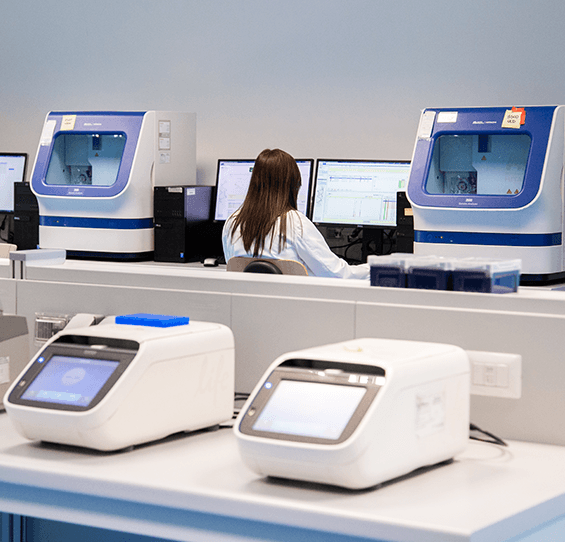
Laboratory bench with genetic analysis equipment, and a scientist at a computer behind it
Pregnancy tissue and parents' blood are analysed with different laboratory methods

What it involves

How parental chromosome testing works

1

Talking it through first

A doctor or genetic counsellor explains why the test is being suggested and what each possible result would mean. Both partners are usually tested, because either could be a carrier. With us, this is usually an online genetic counselling appointment.

2

A blood sample from each of you

The test uses an ordinary blood sample from the arm. It looks at your own chromosomes, so the time since the miscarriage makes no difference.

3

In the laboratory

Blood cells are grown for a short time, then their chromosomes are stained to show light and dark bands. A picture of all 46, the karyotype, is checked for anything missing, extra or out of place.

4

Getting the result

If one of you carries a rearrangement, UK guidance says you should be referred to a clinical geneticist to discuss what it means for future pregnancies and for your wider family. If you test with us, genetic counselling is offered when a result is abnormal, and our Consultant in Clinical Genetics can see you if a fuller review is needed.

Carrier results

What a carrier result means

A carrier result can be unsettling, even when it brings an explanation. Here is what it does, and does not, mean.

01

A carrier's own health is usually unaffected

A balanced rearrangement does not usually affect the health of the person who carries it, and it needs no treatment. Nothing either of you did caused it.

02

Some pregnancies may be unbalanced

It can be passed on in an unbalanced form, which raises the chance of miscarriage. In a Dutch study, about 49 in 100 carrier couples had another miscarriage, against 30 in 100 couples without a rearrangement. A karyotype cannot predict whether a particular pregnancy will be balanced.

03

Healthy children are still the usual outcome

Of the carrier couples in that study, 83 in 100 had at least one healthy child; for couples without a rearrangement the figure was 84 in 100. Another study, with far fewer carrier couples, put their cumulative live birth rate lower, at about 64 in 100. Large studies found an unbalanced pregnancy reaching the second trimester in under 1 in 100 of these couples' pregnancies; one small study found about 3 in 100.

04

Not every loss was caused by it

Even in carrier couples, European guidance links roughly one loss in three to the rearrangement. Others are chance chromosome changes, unexplained, or linked to another factor, so the wider recurrent miscarriage checks still matter.

05

Relatives can choose to be tested

Other relatives of the carrier may carry the same rearrangement. A genetics specialist can support you in sharing the result with family, and in England NHS testing can be offered to relatives who want it.

Looking ahead

Choices for a future pregnancy

There is no single right choice. UK and European guidance both advise genetic counselling to weigh these up, because the best route depends on the rearrangement, your age, your fertility and how you feel. Pregnancy after a chromosomal miscarriage covers tests during pregnancy in more detail.

Trying again naturally

Studies found a similar chance of eventually having a baby after natural conception as after IVF with embryo testing. In pregnancy you can be offered CVS from 11 weeks or amniocentesis from 15 weeks. Done by a skilled specialist, either is likely to add less than 1 in 200 to the chance of miscarriage.

IVF with embryo testing (PGT-SR)

Embryos made through IVF are checked before one is transferred, so IVF is needed even without a fertility problem. Some studies report fewer miscarriages with it, but they have not found that it increases the chance of a baby or shortens the time it takes; it is costly, and embryo testing is not 100% accurate. UK clinics need an HFEA licence; NHS funding depends on your situation and where you live.

Donor eggs or sperm

Using donated eggs or sperm, depending on which partner is the carrier, avoids passing the rearrangement on. UK guidance lists it alongside natural conception and embryo testing.

Taking time to decide

Some couples pause, stop trying or consider other routes to parenthood such as adoption. In two studies, around 1 in 6 carrier couples chose not to try again. Support is available whatever you decide.

NHS and private routes

Arranging parental testing, and getting support

On the NHS, parental testing is usually requested by a recurrent miscarriage clinic, a gynaecology team or clinical genetics, using the criteria above, and is free when you meet them. If a tissue result showed an unbalanced rearrangement, ask whether you have both been referred for testing, and for a clinical genetics referral if a carrier result comes back.

A karyotype can also be done privately, and we can arrange one for either or both of you. Outside the NHS criteria, we suggest talking to a genetic counsellor before testing. It helps you judge whether the result would change anything, and makes sure a carrier result is properly followed up.

Your GP or NHS team is always a reasonable place to start, and our appointments can sit alongside NHS care rather than replace it. The options we offer are set out below.

A carrier result, or a long wait for answers, can affect each partner differently. You can talk to the Miscarriage UK support line on 0303 003 6464, or to a Tommy's midwife free of charge on 0800 0147 800.

How we can help

How London Miscarriage Clinic can help with parental testing

Whether you are deciding if a karyotype is worth doing or already have a result to act on, these are the appointments we offer. No referral is needed, and they can run alongside any NHS care. London Miscarriage Clinic is part of London Pregnancy Clinic, so booking opens on the London Pregnancy Clinic website. You can also call us or message us on WhatsApp.

Online, 30 minutes

Genetic counselling

An online appointment, by video or phone, with one of our registered genetic counsellors, provided with our partner Jeen Health and led by our Lead Genetic Counsellor, Ailidh Watson. We go through your history and any tissue results with you, tell you honestly whether a parental karyotype is likely to help, and explain what each result would mean. For a longer or more complex history, choose the 60-minute appointment.

Only when indicated

Parents' chromosome test (karyotype)

Checks one partner's or both partners' chromosomes for a balanced rearrangement, from an ordinary blood sample. It is most useful in the situations described above, which is why we recommend a genetic counselling appointment before testing. Results are typically back in two to three weeks, and genetic counselling is offered if a result is abnormal. Testing a couple together is £550.

Doctor-led, by enquiry

Clinical genetics consultation

If one of you carries a rearrangement, or your family history is complex, Dr Harry Leitch, Consultant in Clinical Genetics, can review your results and advise on what they mean for future pregnancies and for relatives, including choices such as embryo testing or testing during pregnancy. Appointments last 30 to 90 minutes, by video or in clinic, and are arranged by enquiry.

After repeated losses

Recurrent miscarriage package

A karyotype looks at only one possible cause of repeated losses. This package, at our City clinic, includes a consultation and pelvic scan with a consultant gynaecologist and blood tests that include antiphospholipid antibodies (lupus anticoagulant and anticardiolipin antibodies) and thyroid function. A £300 deposit secures your appointment and comes off the total cost. A karyotype is not included and is arranged separately.

FAQs

Questions couples ask about parental chromosome tests

Does a trisomy in the pregnancy mean we should be tested too?

In most cases, no. An extra whole chromosome, such as trisomy 16, is usually a chance error in the making of an egg or sperm, and becomes more common as the person providing the egg gets older. UK guidance links parental testing to unbalanced structural results, not to trisomies.

Rarely, a trisomy comes from a Robertsonian translocation in a parent. If your report or history suggests this, a genetics team may recommend testing. Understanding your result explains common report wording.

We have had two miscarriages and neither was tested. Can we ask for a karyotype?

You can ask, but in England the NHS is unlikely to offer it yet: without a tissue result, its criteria cover three or more losses where a sample could not be tested, or five or more losses with none tested. ESHRE, which counts two losses as recurrent, suggests testing only after an individual risk assessment that includes your family history.

If there is another miscarriage, testing that pregnancy usually tells you more. If you would still like a karyotype, we can arrange one privately; a genetic counselling appointment beforehand helps you decide whether it is likely to be useful.

If one of us turns out to be a carrier, is it that person's fault?

No. Carriers are born with the rearrangement, and it usually causes no symptoms, so they generally have no way of knowing unless they are tested. Nothing either of you did could have caused or prevented it.

The partner who carries it may still feel guilty, and both of you may need time. Genetic counselling is for the couple, not only the carrier, and Miscarriage UK supports anyone affected by pregnancy loss.

Does being a carrier mean our next pregnancy will be unbalanced?

No. Each pregnancy starts from a new egg and sperm, and a karyotype cannot predict which arrangement it will inherit. If you become pregnant, a diagnostic test (CVS or amniocentesis) can check the pregnancy's chromosomes.

What can a parental karyotype not tell us?

It cannot show whether a particular past miscarriage was caused by a rearrangement. It does not look at changes within single genes, and some very small changes need a more targeted test than a standard karyotype.

A normal result is the most common outcome, but it does not account for repeated losses by itself. After recurrent miscarriage, doctors usually also look for antiphospholipid antibodies, check thyroid function and assess the shape of the womb; our page on recurrent miscarriage explains why.

Do we need a GP referral to be tested with you?

No. You can book genetic counselling or a karyotype with us yourself, for one partner or both together. If you are not sure the test is right for you, start with an online genetic counselling appointment, where we look at your history and any tissue results before you decide.

If you meet the NHS criteria described above, parental testing through your NHS team is free, and we are happy to say so if that is the better route for you.

About this information

This page summarises UK and European guidance and published research on testing parents' chromosomes. It cannot assess your own circumstances, and decisions about testing are best made with your doctor or a genetics professional, whether that is your NHS team or ours. If you are pregnant and have heavy bleeding or severe pain, develop a fever or feel faint, phone your early pregnancy unit or 111 for urgent advice, and dial 999 in an emergency.

Contact

Wondering whether you need parental testing?

Send us an enquiry

Ask whether a karyotype is likely to help, about a result you already have, or which appointment suits you. Not for emergencies: if you have heavy bleeding or severe pain, call 999 or go to A&E.

For urgent matters please call 020 3687 2939.

Sources & clinical references

The figures and clinical statements on this page are drawn from the sources below. Guidance evolves — always discuss your individual circumstances with a clinician.

  1. Royal College of Obstetricians and GynaecologistsRecurrent Miscarriage (Green-top Guideline No. 17)2023
  2. Royal College of Obstetricians and GynaecologistsRecurrent miscarriage (patient information)2023
  3. NICE Clinical Knowledge SummariesMiscarriage: what are the risk factors?2023
  4. European Society of Human Reproduction and Embryology (ESHRE)Recurrent pregnancy loss guideline, update 20222023
  5. NHS EnglandNational Genomic Test Directory: testing criteria for rare and inherited disease, version 9.1 (R464 and R465)2026
  6. NHS England Genomics Education Programme (GeNotes)Presentation: patient experiencing recurrent miscarriage2026
  7. BMJ (Franssen et al.)Reproductive outcome after chromosome analysis in couples with two or more miscarriages: case-control study2006
  8. Molecular Cytogenetics (Wu et al.)Comprehensive analysis of early pregnancy loss based on cytogenetic findings from a tertiary referral center2021
  9. National Human Genome Research Institute (NHGRI)Chromosome abnormalities fact sheet2020
  10. Human Fertilisation and Embryology Authority (HFEA)Pre-implantation genetic testing for monogenic disorders (PGT-M) and chromosomal structural rearrangements (PGT-SR)2026
  11. Royal College of Obstetricians and GynaecologistsAmniocentesis and Chorionic Villus Sampling (Green-top Guideline No. 8)2021
  12. Miscarriage UKMiscarriage UK (working name of The Miscarriage Association): support and informationAccessed October 2026